

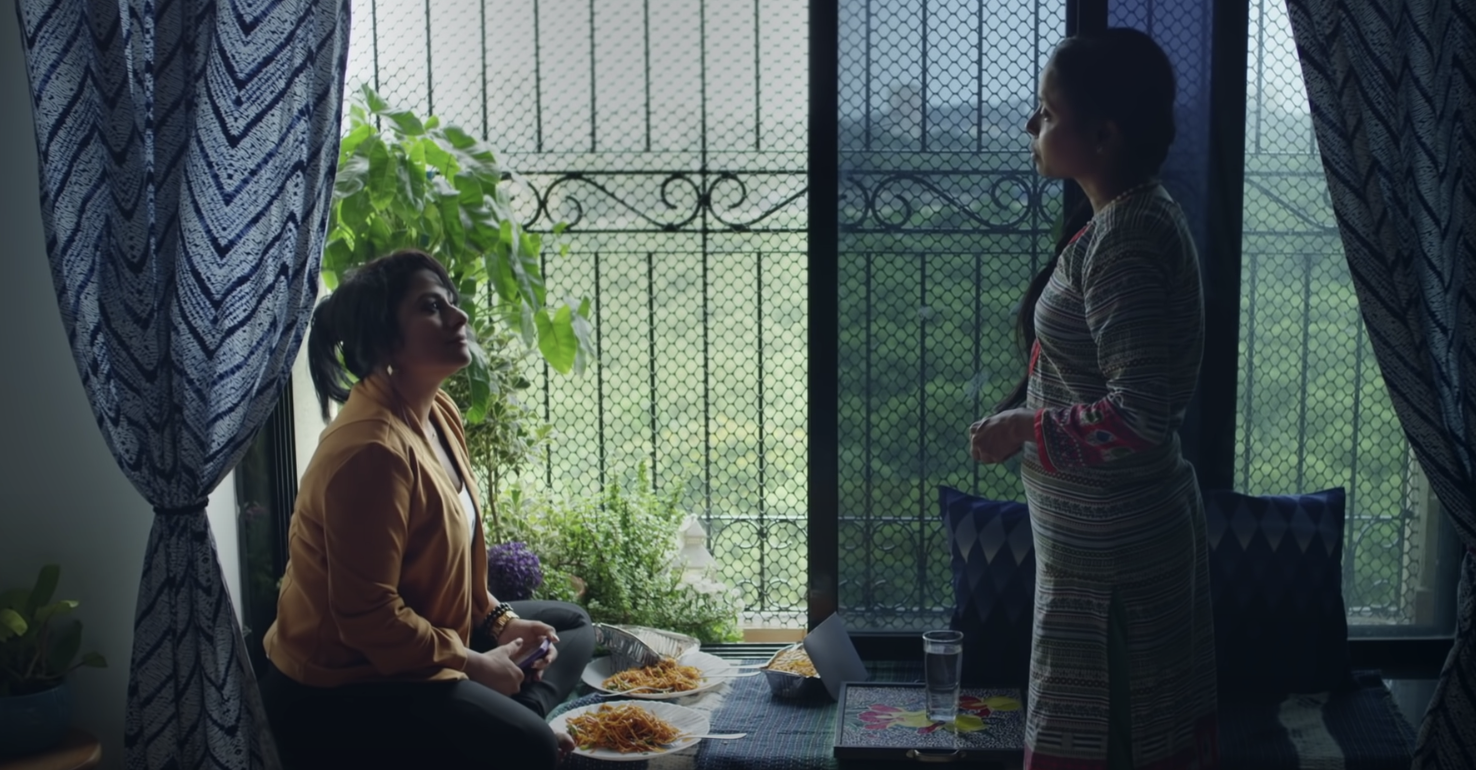
Written and directed by Surabhi Saral Sachdev, ‘Chi Chi’ is a curious short film that steps wonderfully into the idea of delivering a message before it turns itself on its head, dropping, on you, the realization that biases are only ever apparent when it comes from someone else. If I really had to be blunt, ‘Chi Chi’ serves as a commentary on that very idea. It is not a short film about abandoning our biases as much as it is a film about the idea of how much we are willing to forgive when it comes to our own selves.
The premise of ‘Chi Chi’ is simple enough. Shreya, played by Sai Deodhar, is paying a visit to her colleague, Juhi, played by Ritu Choudhary Seth. Tagging along with Shreya is her toddler and her helper, Shabana, played by Amrita Chowdhary. The purpose behind the visit, itself, is so that Shreya and Juhi can catch up on their workload. The two of them, having recently become mothers, have a stark contrast to their daily lives. Shreya, owing to Shabana’s help in household chores, has a much better time dealing with the responsibilities that a new parent has. You understand the extent of it when you see Shabana, walking a few paces behind Shreya, carrying bags filled with whatever her employer would need.
Juhi, meanwhile, is not faring as well as her colleague. Constantly between hiring new domestic help, Juhi seems to be struggling with everything that comes with becoming a new parent. Funnily enough, her husband does not seem to be anywhere in the picture when it comes to helping around. That aside, the meat of the short film comes from the difference in the manner in which Shreya and Juhi treat Shabana.
Juhi, especially, seems to regard Shabana with a defined sense of social distinction. As the narrative progresses, the audience bears witness to Shreya being disappointed with her colleague’s behaviour before she finally decides to leave.

It is only when Shreya returns home, with her child and Shabana in tow, that you understand that Shreya’s biases are no different from Juhi’s. The sole reason that it doesn’t become apparent is owed to the fact that, perhaps, Shreya’s biases are a little less overt. Nonetheless, they exist for certain.
Surabhi Saral Sachdev, through ‘Chi Chi’ has done a wonderful job at capturing the idea that our judgements don’t extend to our own actions. Sachdev positions Juhi’s character as a representation of the obvious, the blunt, the downright apparent practices that furthers social stigma. Shreya, as a character, serves as the covert variant of the same practices, insidious but no less damaging to an individual’s sense of dignity.

‘Chi Chi’ is a short film that is not what it appears to be on its surface. Like the characters it contains, it goes a little deeper.