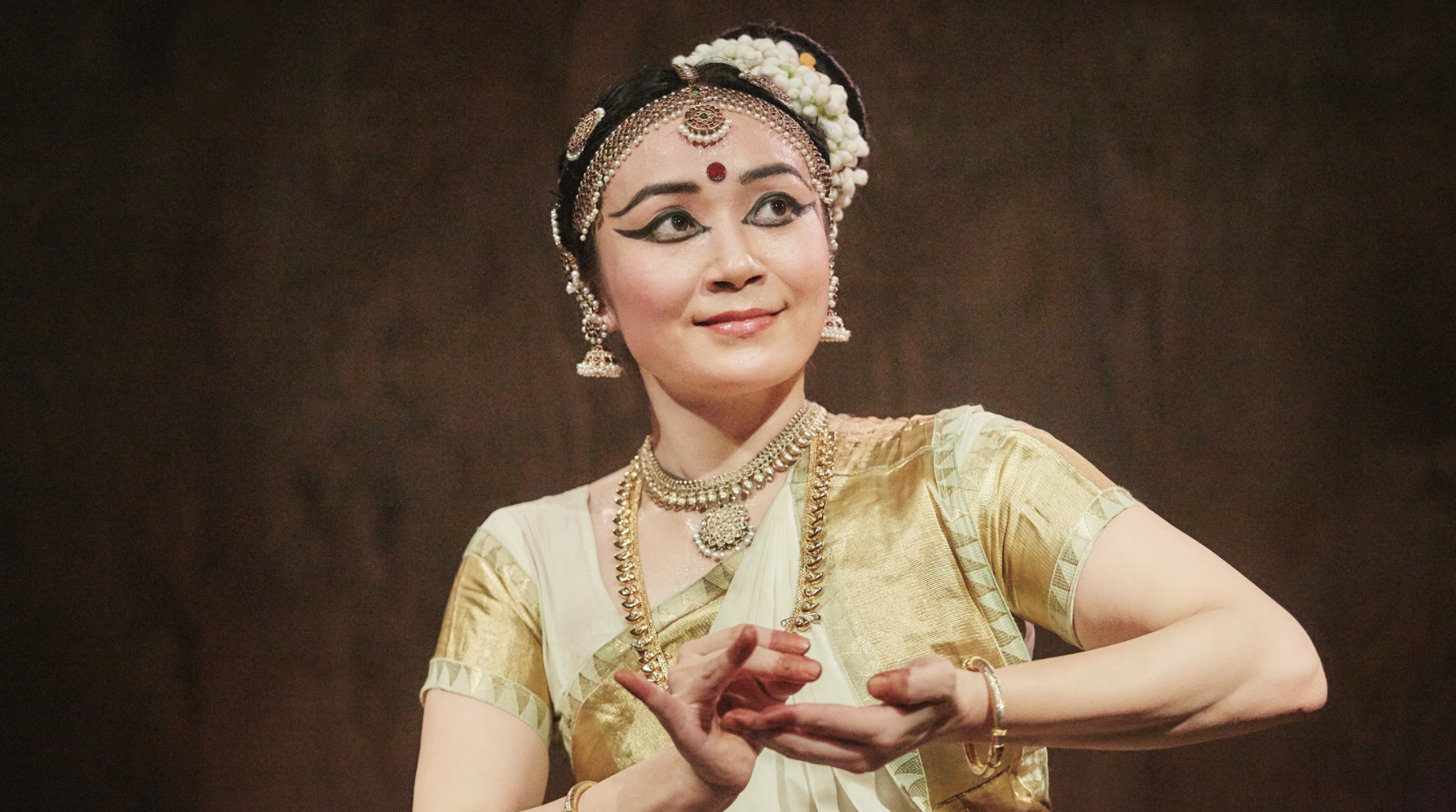
“Art crosses all barriers”, and indeed it does. Art is the bridge between languages, traditions and cultures. Dance form then becomes one of the crucial art forms which transcends these societal barriers and unites us all. Keiko Okano is a living example of this unification. She’s a Mohiniyattam dancer hailing from Japan. She has been practising Mohiniyattam for a decade and a half now. Her journey has been a confluence of cultures, of transitions, and most importantly, of locating oneself in the variegated art form.
Early Life
Japan-born Keiko Okano always wanted to move out and explore. She didn’t want to be restricted to one place. So, at the age of 17, she moved to the USA for her higher studies. The USA is the hub of western culture. America houses people from different walks of life. Moreover, there’s a plethora of differences and variety between the cultures and the art. Keiko’s interests in the western art, however, led to a different revelation. Staying in a predominately western culture, Keiko could feel her Asian identity even strongly. The multi-layered Asian culture was becoming clearer to her. It was in the US where Keiko got introduced to the Indian culture, which led her curiosity to Indian traditional art forms and later encountered Mohiniyattam.
The Opening of Doors to Mohiniyattam
Keiko Okano started practising Mohiniyattam in Japan, under her former teacher, Hiromi Maruhashi. A few years later, Keiko travelled to Kerala, and there she witnessed the art form in its true entirety. Keiko Okano says that the very air of Kerala was distinct, and it made her feel more connected to Mohiniyattam than in Japan. Even the intense training at Kerala grasped Keiko Okano wholeheartedly, and since then, she hadn’t wanted to let go of the lands of Kerala.
Keiko strongly wished to learn Mohiniyattam in its origin, in Kerala. She joined Natanakaisiki Mohiniyattam gurukulam, Natanakairali in 2010 and started her rigorous training under Guru Nirmala Paniker, director of Natanakaisiki Mohiniyattam Gutukulam, Natanakairali, Kerala.
In this journey, her guru, Nirmala Paniker, has been her biggest inspiration, and her favourite artist. Keiko says that even to this date, her Guru’s beautiful abhinaya and extensive knowledge motivate her to practice even harder. She wants to attain in herself the grace and experience as her. Needless to say, Mohiniyattam has been a spiritual journey for her. It has been incomprehensible for Keiko to describe how performing and practising Mohiniyattam unites her body and mind into one.
Since Keiko was from Japan, language also posed a barrier at times. Training was possible in English but in a deeper sense, it requires the language of the origin to understand further and develop. Her guru used to converse and teach her in English, and more often than not, her classmates helped her understand a lot of dance techniques, nuances and meanings. Recently during the pandemic, she had stayed in Kerala and started focusing on Malayalam language studies.
She aims to get well versed with it so that she can also connect with the local people of Kerala to deeply understand the culture and its art forms. She highlights that some knowledge and lessons can only be taken by immersing with the locals of the land, who’re the place’s elixir.

Mohiniyattam Through the Eyes of Keiko Okano
Keiko Okano presents her views, knowledge, and experience of the revered dance form of Mohiniyattam. All of this, she has derived from her Guru, who has been invested in the research of the Sangam Literature and Cilapattikaram. Guru Nirmala Paniker dedicated her life to research and bringing back the missing links of the old Kerala female traditions and revived back the Desi repertoires of Mohiniyattam.
Each guru and dancer has its own style. Her guru, Nirmala Paniker, also created and established her own style of Mohiniyattam. Keiko’s one of the speciality and training has been in Abhinaya, the subtle expressions using the techniques of Kutiyattam. She has learned this unique style of Mohiniyattam from her Guru Nirmala Paniker who is also a researcher on Nangiarkoothu (a female solo performance, an offshoot of Kutiyattam). Keiko had also blessings to practice special abhinaya training in Kutiyattam exponent Guru G Venu’s Navarasa Sadhana and a practice session by renowned Kutiyattam artiste and dancer, Smt. Kapila Venu. It immensely helped her to grow as a performer and acting techniques. Kutiyattam, an authorised UNESCO art form, is an ancient Sanskrit theatre and mentioned in Sangam Literature.
Keiko Okano also reveals how the majority of the common audience does not grasp Mohiniyattam in its true entirety. Popular culture doesn’t appreciate the traditional dance form. More than that, they don’t know about Mohiniyattam and have a vague stereotype in Kerala. Audience is limited, and even the ones who practice are limited to certain people. This beautiful art form should be more reaching to locals and to wider audiences in Kerala and outside, even globally. However, the communication and subtle expressions which make the dance form unique can be reached to the audiences. Through the experience of performing in India, and outside India like Japan and Pakistan, she realised that the art she learned from her guru is beyond the culture. Bunvat International Festival in Karachi, Pakistan in 2019 was a remarkable experience, the performance was highly appreciated and touched the audiences of Karachi. It was a realisation of moments.
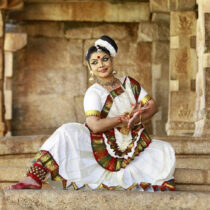
In a dance form like Mohiniyattam (or Kutiyattam), the body is also the eyes through which the dancer expresses various emotions. The Abhinaya is very prominent in bringing these emotions in Mohiniyattam, driving the feminine power and communicate through the dance. A smooth flow is therefore created between the body movements and powerful expressions. Keiko highlights a beautiful resemblance of this dance form with the slow tempered, tropical nature of Kerala, its soothing yet deplorable waves, coconut leaves, its land and its people.
Apart from the Hindu mythologies which Mohiniyattam depicts, Keiko also wants to try to incorporate the stories of the local people of Kerala or Japan and see the possibilities of creating art through what she learned from this art form.

Message for the Young Aspiring Artists
Keiko Okano believes that something can not just be achieved through innate talent. A person has to work and practice hard to hone one’s skills, and be as perfect as possible. As a Japanese, Keiko says that even the body language of Japanese and Keralites is different. Therefore, while performing Mohiniyattam, she had to rigourously practice attaining that equilibrium. Even the simple gestures, Abhinaya (expressions) all she tried to gain by being with locals and observing them and experiencing the life in Kerala. The talent is important yet it is more important to understand the talent in self and have the eyes to observe the possibilities within. Throughout her earlier years of her dance journey, Keiko had such days and conflicts too when she wondered if she can continue the practice or not. It was not so simple or easy to have an art practice focused life. However, at the end of the day, the classes and the practice of the dance made her realise she was indeed doing what she truly wanted. This kept her motivated to continue.
To the young aspiring artists, she asks them to stay dedicated and be patient to their art. Keiko learned the dedication and patience from her gurus at Natanakairali. Staying in a gurukulam, being closer to the art master family, she experienced them live for art, their dedication and uncompromising life. She also says that you should not invalidate your inner feelings about the art you want to pursue and not be perplexed by those who discourage you. She also highlights how because of age or looks, we often think we’re too late now to pick it up, but completely push this restraint away, and know that you’re never too late to begin. And lastly, appreciate your failures and mistakes, because they make us stronger.