

Change happens in a society almost at the speed of light. Just blink and you miss it. Be it people, values, technology And yes, even poetry. There always seems to be some kind of contention between generations. With each party stubbornly convinced that their way of living is absolutely right. But what triumphs over our differences is our experiences-our shared history, heritage and feelings.
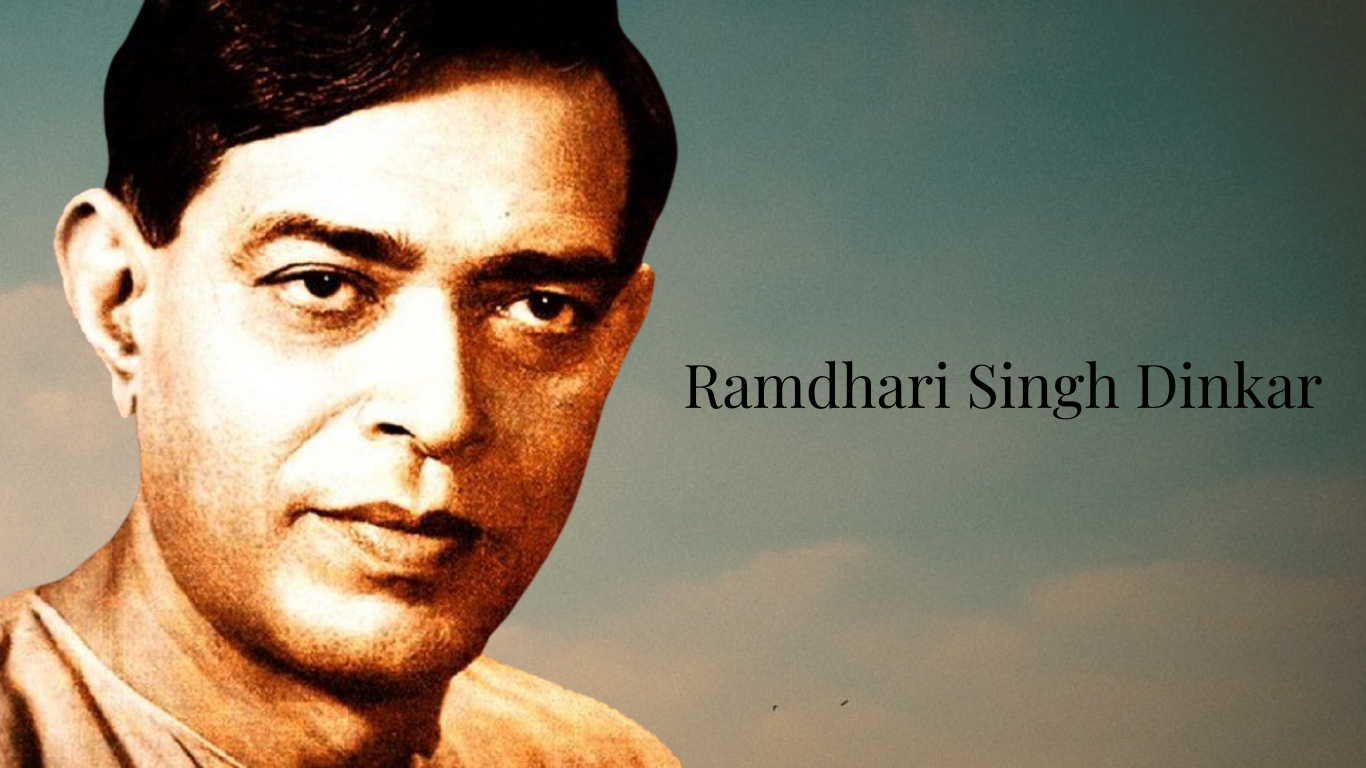
Today is a day when we pay homage to one of our nation’s greatest poets. And certainly, one who defined the spirit of nationalism for many to come — Ramdhari Singh Dinkar. His longevity is forever etched in public memory as we now remember him as a ‘rashtrakavi’(national poet). At a time in the world where we seem to be standing at the crucible of moral, environmental and political crisis; it’s worth revisiting a young man who got inspired to contribute to one of the greatest freedom movements of all time.
रात यों कहने लगा मुझसे गगन का चाँद,
आदमी भी क्या अनोखा जीव होता है!
उलझनें अपनी बनाकर आप ही फँसता,
और फिर बेचैन हो जगता, न सोता है।
रामधारी सिंह दिनकरी
Early Life
Ramdhari Singh Dinkar was born to Babu Ravi Singh and Manroop Devi in the Simaria district of Begusarai. He was a studious and noticeable student who from a very young age was exposed to the unfairness of living a life in economic discomfort. And as a student and connoisseur of poetry, he was greatly influenced by poets of all languages like English, Bengali, Hindi and Sanskrit. He was so passionate about poetry that he would translate Tagore, Milton, Igbal and Keats.
Adolescence is extremely absorbent, by the time Dinkar reached adolescence, the Indian Freedom struggle had gained formidable momentum. It was the nationwide protests against the Simon Commission which ignited his poet’s fuel and prompted him to pick up the pen. Inspired by the peasant satyagraha led by Sardar Patel, Dinkar wrote 10 poems which were published together as ‘Vijay Sandesh’ (Message of Victory).
दो में से क्या तुम्हे चाहिए कलम या कि तलवार
मन में ऊँचे भाव कि तन में शक्ति विजय अपार |
रामधारी सिंह दिनकरी
Poetry and Politics
Dinkar first saw Mahatma Gandhi in 1920 the same year in which he founded a library named Manoranjan Library. Although he deeply resonated with Gandhian philosophies of non-violence, he called himself a ‘bad Gandhian. Years of poverty and witnessing brutality had ignited something within him. Even in his works, he would always rally the people to not let the oppressors go unscathed and unaffected. By all means, Rashtrkavi Dinkar was a poet of the people.
He served our country in a parliamentary capacity as well. After doing two terms in Rajya Sabha, he was appointed the National Hindi advisor. One of the epochs of his poetic prowess is the work ‘Sanskriti ke Chaar Adhyay’ explores the four big cultural revolutions that India has seen. And through this magnum opus, he only goes on to show how India is an integrated and diverse melting point for all cultural identities. His poems on the tragic son of Kunti, Karn from the Mahabharat clearly shows his disdain for the caste system and the discrimination that came along with it.
As one can see, these are values that are adopted even today, even seventy-four years post-independence. Perhaps this was the quality that earned Ramdhari Singh Dinkar the Sahitya Akademi Award in 1959. As well as the Padma Bhushan in the same year. In 1974, the Rashtra Kavi passed away at the age of 65 leaving an indelible legacy for all of us.
सच है, विपत्ति जब आती है, कायर को ही दहलाती है,
शूरमा नहीं विचलित होते, क्षण एक नहीं धीरज खोते,
विघ्नों को गले लगाते हैं, काँटों में राह बनाते हैं।
रामधारी सिंह दिनकरी