
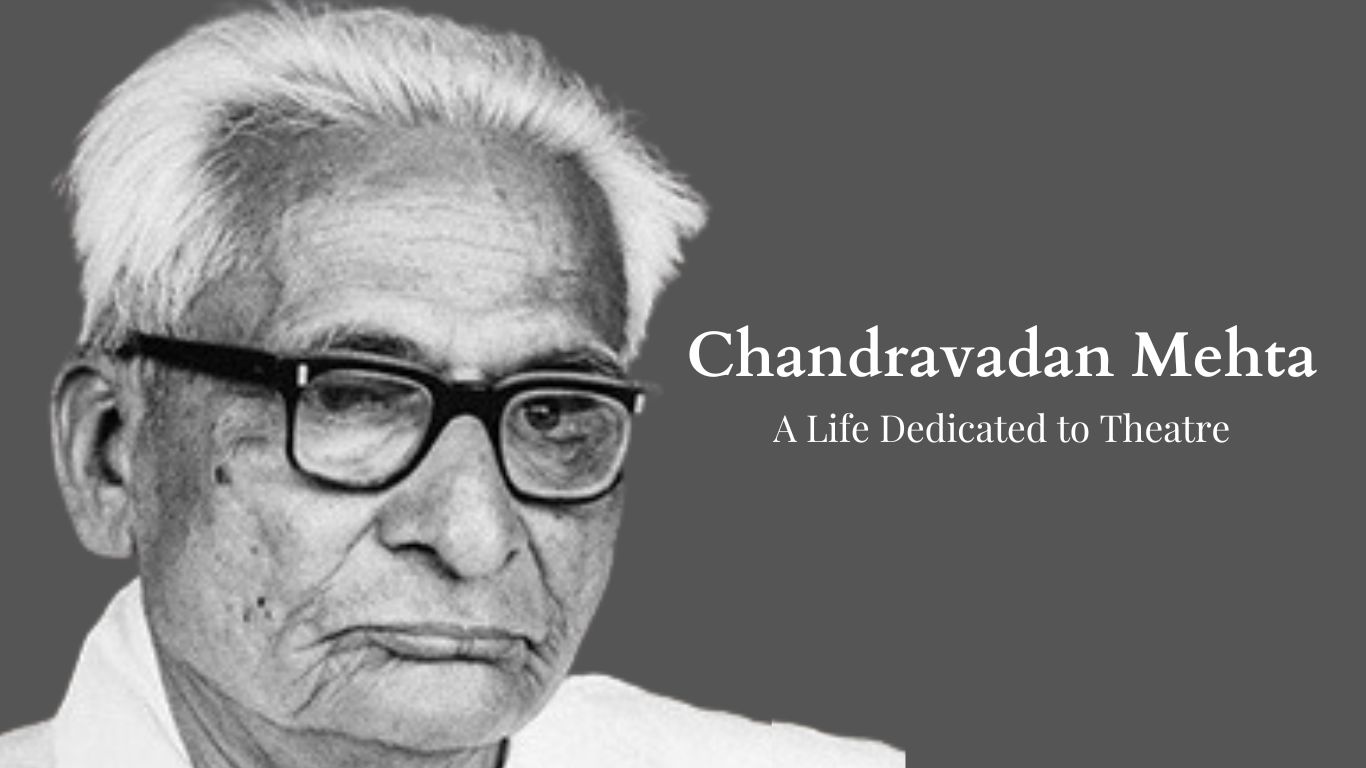
Finding one’s passion and dedicating your entire life to it is not as easy as one might think. First of all, finding a passion that you want to stick to for a long time is hard, imagine sticking to it for so long even when it isn’t developed enough at the place you are exploring it. It’s always easier to learn or get passionate about things that are already well-established. But imagine being passionate about something and making the roadmap for that very thing as you explore your passion. Not so easy and it isn’t for everyone. Chandravadan Mehta was one such individual who lived such a life.
Chandravadan Mehta: Love For Theatre
Born in Surat in 1901, Chandravadan Chimanlal Mehta or also known as C. C. Mehta or Chan. Chi. Mehta was a renowned Gujarati poet, playwright, bibliographer, theatre critic, travel writer, story writer, broadcaster and autobiographer. Finishing his schooling first in Vadodara and then in Surat, he completed his B. A. in Gujarati from Elphinstone College, Bombay. He initially started his professional career as an editor for Navbharat daily and then switched to teaching and then switched to broadcasting by becoming the director of AIR-Ahmedabad in 1954.
Throughout his career, he tried to incorporate his love for the world of theatre in one form or another. By writing and producing several radio plays and documentaries with directors like Adi Marzban and others, he ensured the broadcasting culture in Gujarat flourished and his passion was kept alive. Regarded as the pioneer of modern Gujarati theatre, Chandravadan Mehta loved to dabble his hands in various genres. His play ranged from tragedy to historical to satirical to mythological to biographical.
Causing a stir by presenting two unscripted soliloquies in 1920, Chandravadan Mehta has written over 25 plays and several one-act plays and radio plays during his lifetime. Some of his realistic plays include; Akho (1927), Agagadi (1933), etc. His other plays include; Mena Popat Athva Hathighoda (1951), Rangbhandar (1953), Sonavatakdi (1955), Madira (Media) (1955), Kishor Natako Part 1-2 (1956), Kapoorno Deevo (1960), Param Maheshwar (1960), Sati (1960), Karoliyanu Jalu (1961), Shakuntala Athva Kanyaviday (1966), Andar Andar (1969), Abola Rani (1972), Santakukadi (1972), Chandravadan Mehtana Pratinidhi Ekankio (1974), etc.

Chandravadan Mehta: Other Career Ventures
Greatly invested in Gujarati theatre, Chandravadan Mehta researched and wrote extensively about it and the production techniques used in the same. His work, Bibliography of Stagable Plays in Indian Languages Part 1-2 (1964, 1965), contained an extensive list of plays that were written and staged in India during the 19th and 20th centuries. Arranged according to years, writers and characters, this list took 10 years before it was completely ready. This work received a lot of acclaim from the theatre of Europe as well.
Owing to his vast knowledge and expertise in theatre and stagecraft as well as in international theatre, it is no surprise that he indeed dabbled his hands in theatre criticism as well. He has written a total of 11 works on theatre criticism, some of these are; Kavishri Nanalalna Natako Ane Akbarshahni Rangbhumi Par Rajuat (1959), Natak Bhajavata (1962), Lyric (1962), Lyric Ane Lagarik (1965), Natyarang (1973), American Theatre (1974), Europe na Deshoni Natyashrishti (1974), etc.

Apart from being a great playwright, he was also a great poet and storyteller, some of his works in poetry are, Yamal (1926), Elakavyo (1933), Ratan (1937), etc. Some of his works in story writing and prose writing include Khamma Bapu (1950), Vatchakaravo (1967), Bandh Gathariyan Part 1-2 (1954), Chhod Gathariyan (1956), Safar Gathariyan (1956), etc.
Afterword
After his retirement, he associated with the performing arts department of the Maharaja Sayajirao University of Baroda and the Gujarat Vidyapith where he imparted his extensive knowledge of theatre. He pioneered theatre education in India by initiating diploma and degree courses in the same subject at the Maharaja Sayajirao University of Baroda. He not only represented India in the international sphere but also moved a resolution to celebrate 27 March, as World Theatre Day at the Vienna Conference at the International Theatre Institute under the aegis of UNESCO in 1960.
His undying passion for theatre didn’t go unnoticed as he was honoured with a Padma Shri by the Indian Government along with various other awards such as the Ranjitram Suvarna Chandrak award, the Narmad Suvarna Chandrak award, the Sahitya Akademi Award for the Gujarati language, the Sangeet Natak Akademi Award for playwriting in the Gujarati language, etc.