

It’s often said in Indian society that it’s a woman who builds the home. But it so happens that it’s that same home that ends up becoming a prison for her. It’s the same home that nurtures everyone and ends up curbing her wishes and dreams. It’s the same home that does provide her comfort but with a high price of suffocation. It so happens that she builds it but we dictate how the home functions, taking away the authority she carried with the home. The short film Chaukhat reminds us of this ordeal in a very practical situation.
Chaukhat: A Closer Look
Directed, written and edited by Asif Khan, Chaukhat tells the story of a woman who must make a decision regarding her own life which involves going beyond the four walls of her home, in order to ensure a better life for her and her daughter. In Hindi, Chaukhat literally means the “door frame” of a house or home. Throughout the film, the Chaukhat of the female protagonist’s home has been used as a metaphor to decide her freedom as a woman.
Grappled with poverty and a desire to ensure that her daughter receives the best possible education Sangeeta our protagonist in the film wants to work to provide for her daughter. But bound by the Chaukhat that her mother-in-law drew for her, she is unable to step outside. It takes a lot of persuasion and faith in herself that finally push Sangeeta to cross the Chaukhat.
The film overall is a rather inspiring one. By making the protagonist as ordinary as possible the writer allows the audience to relate more to her and the story. As the logic is simple, it can be anyone’s tale. Thus, it heightens the impact of Chaukhat. The actors especially the protagonist Sangeeta have done a phenomenal job at portraying the desperate conditions that one may be pushed to by life. The setting of the film in a tiny one-room along with the drabby clothing that the characters don does the job of conveying the desperation of their situation.
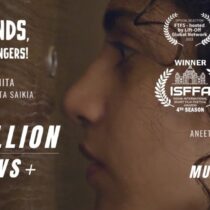
The choice of the mother-in-law to wear the same outfit while others around her change their outfits every five minutes or so including the protagonist Sangeeta is symbolic of her rigid attitude and behaviour. Further, a closer look at the pattern of her saree which is just plain straight checks highlights the unflinching attitude that people have carried for centuries even women. It can also be a nod to why women continue to carry the mantel of patriarchy as was pointed out by Richa Chilana in her research paper titled, “There’s something to be said, / after all, / for giving in”: An Analysis of the Veil in Imtiaz Dharker’s Purdah and I Speak for the Devil. In the paper, Chilana points out how the very fact that the mantel of power given to a woman in patriarchy is cyclical in nature, resulting in the tormented bahu (daughter-in-law) becoming the decision-making saas (mother-in-law) in the future, the saas continues the cycle of torture instead of breaking it as she will get her share of power then.
Although the storyline of the film may carry a punch, it’s camera-work can surely do with some more direction. The various camera angles and the way the focalisation was executed were very reminiscent of the early 2000s Indian Soap opera shots, which may seem a little dated given that the film was released in 2024. But if the film intended to pay an ode to the old saas-bahu serials that first propagated this narrative of Chaukhat and crossing it, then the camera angles make complete sense.

Afterword
Overall Chaukhat is a film that needs to be seen to help people understand the issue surrounding the idea of freedom for women from different sections of society. Given the short duration of the film, it is commendable what the protagonist and others have managed to capture.