

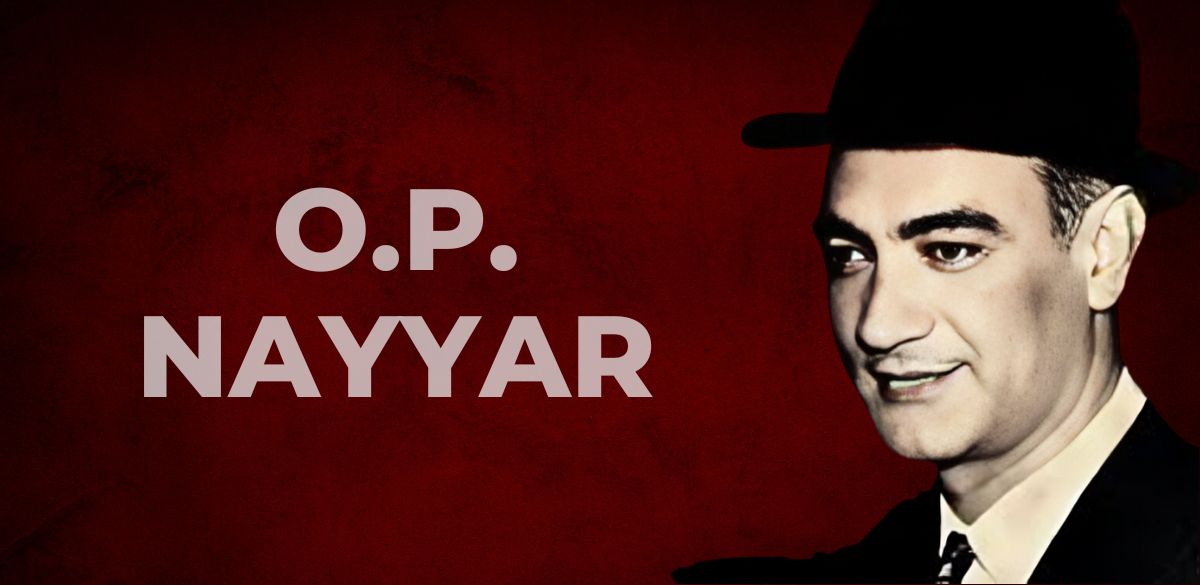
With his music characterised by rhythmic exuberance and melodic richness, he has remained a legend with the audiences even after two decades of his death. O.P. Nayyar was born on January 16, 1926, in Lahore, then British India, since he was identified with the golden age of Bollywood music. His lush compositions evolved the sound of the ’50s and ’60s, along with the contributions of other legendary directors such as S.D. Through their outstanding songs, Burman and Laxmikant-Pyarelal gave birth to a new wave of substantial musical talents, including singers like Geeta Dutt, Asha Bhosle and Mohammed Rafi.
Early Life and Career Beginnings
O.P. Nayyar had a different turn in his life when he entered the music field. Born in Lahore, Nayyar grew up in a family with no formal background in music. He was virtually self-taught, playing the piano, dholak and drums. Nayyar’s instinctual grasp of tunes and rhythms transcended his lack of formal training and helped him find his place in the intensely competitive world of Bollywood music.
His career began during the early 1950s. In 1949, he did the background score for Kaneez, while in 1952, he was credited with being the music director of his first film, Aasmaan. With such early films as Chham Chhama Chham (1952) and Baaz (1953), some of O.P. Nayyar’s styles started to shape up, blending catchy rhythms with beautiful melodies.
Collaboration with Bollywood Legends
Nayyar managed to spot and collaborate with some of the finest singers in Hindi cinema. It was Nayyar’s collaboration with a voice that matched his composition’s energy and mood. Iconic singers such as Geeta Dutt, Mohammed Rafi and Asha Bhosle had Nayyar as their primary music director. Of all his associations, with Asha Bhosle in particular, Nayyar’s was hallowed; they would together dish out a string of unforgettable hits, including Kajra Mohabbatwala from Kismat (1968) and Aap Ke Haseen Rukh from Baharen Phir Bhi Aayengi (1966).

The voice of Asha Bhosle, entirely overshadowed by that of Lata Mangeshkar early on, blossomed under Nayyar’s direction. Nayyar helped Asha break the age-long constraint of being Lata’s sister, proving herself to be an overpass-singer who has versatility as a playback singer with a distinctly catchy voice, capable of singing anything from mellow romantic ballads to some quite vivacious up-tempo numbers.
Nayyar and Mohammed Rafi gave some of India’s most lasting songs. Nayyar’s great rhythm-filled compositions became truly remarkable with Rafi’s poignant voice. Songs like Yeh Desh Hai Veer Jawaanon Ka from Naya Daur (1957), which brought him the Filmfare award for Best Music Director, are immortal.

The Rise of the “O.P. Nayyar Sound”
In the 1950s and 1960s, O.P. Nayyar became known for creating what seemed to be the “O.P. Nayyar sound.” Catchy tunes characterised his music and catchy rhythms with bold orchestration. Nayyar was particularly fond of dholaks and percussion instruments gave his songs energy and an exciting flourish. He composed with apparent rhythmic dexterity that differed from the icy classical and orchestral sound of the time.
The rhythmic mastery was shown in numbers such as Pyaar Mein Dil Pe Maar Ke from Aar Paar (1954) and Aaja Aaja from Teesri Manzil (1966), where Nayyar reincarnated Western influences into an Indian classical setting to create newer and exciting sounds.
Personal Life and Controversies
Besides being one of the best-known names in Bollywood, O.P. Nayyar had controversy in his personal life and he was known for his tempestuous relationships with some of his collaborators. Perhaps the most heated and famous was with Asha Bhosle, who, even though they had worked on numerous hits together, had a much-publicized split with him in 1974. The exact reasons for their separation remain unclear, but, like many of Nayyar’s relationships, theirs was one of tremendous insecurity and nerve.
Holding out from Bhosle, Nayyar also became estranged from his family. After leaving his Mumbai residence in 1979, he began living alone, first in a hotel and later with singer Madhuri Joglekar. Nayyar became increasingly reclusive and strained in his family bonds by his waning years. He ended up spending his last years alone, requesting explicitly that his family members not be allowed into his funeral due to his death by heart failure on January 28, 2007.

Despite his struggles, Nayyar continued to command high respect in the industry and a flood of condolences and tributes from fellow musicians and Bollywood filmmakers erupted upon his demise.
The Enduring Legacy of O.P. Nayyar
O.P. Nayyar’s music remains etched in Bollywood. He has composed some great rhythms and straightforward but melodious numbers, which will linger on for generations. He shaped the careers of some of the biggest stars in the industry and is among the key architects of the golden era of Hindi film music.
India Post released a commemorative stamp in 2013 to celebrate his genius, forever marking him as one of the most prominent music directors in Indian cinema. Even in his absence, his music carries a message of physical existence and rejuvenation.

