

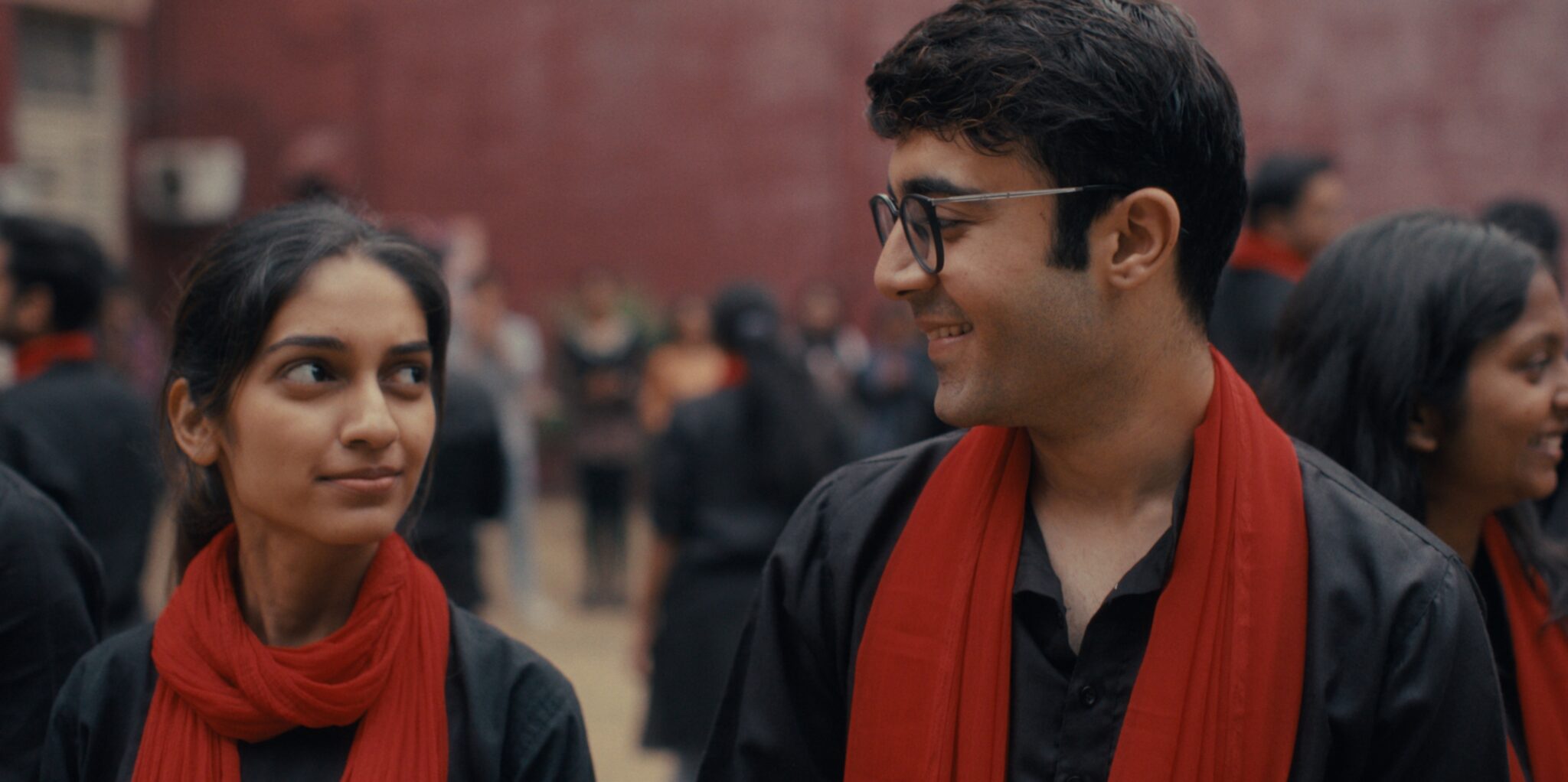
There is a scene embedded somewhere in the origin story of Nukkad Naatak that the film never shows you, but which explains everything about it. It is Diwali 2022. Tanmaya Shekhar, IIT Kanpur economics graduate, HBO production veteran, Brooklyn-based filmmaker, has returned home to visit his family in Jharkhand. His mother takes him to the basti on the edge of the IIT campus, where she has been quietly teaching children for over a year. Something shifts in him.
“It felt like two different Indias. On one hand, you have an elite engineering college. And right next to it, a slum. Their lives don’t intersect. The people from the slums don’t go there, and vice versa.”
Tanmaya Shekhar
That moment where two Indias stand together, but their stories are complete opposite of each other became the beating heart of Nukkad Naatak. The film releases today February 27, 2026, on 100 screens across India. It is the most unlikely theatrical debut of the year: no bankable stars, no studio backing, no industry godfather. Just a film that refused to stop existing.
The Dream Team Behind It All
The man who walked away from from a stable life, Tanmaya Shekhar. He had exactly the kind of life that most of us would dream, IIT, a job in New York, well settled, right? Not quite. He came back to India during COVID and saw the story of two Indias. He decided to tell that story.
And then there was the woman who made the dream real, Molshri, the lead actor, co-producer and co-founder of Kayaantaran Studios. A DU alumna with roots in street theatre at Prithvi and the NCPA, she came aboard as both the film’s backbone. Her performance earned a Best Actress award at a London film festival.
The Making
Funding came from roughly 30 people, family, college seniors, strangers, who believed in a film with first-time actors and a debutant director. The shoot happened on the IIT (ISM) Dhanbad campus, where Tanmaya’s father teaches. The 15-person crew stayed at the Shekhar family home, where Tanmaya’s mother and grandmother ran the catering.
After completion, Tanmaya and Molshri spent six to seven months hitting every wall the industry has. Production houses didn’t respond. OTT platforms heard the names of unknown actors and went quiet. Messages were left on read. Over 1,000 independent films are made in India every year; more than 90% never reach an audience.
So they took the film directly to the people. They loaded into a caravan and drove from Mumbai to Kolkata over five weeks, through 12 cities, performing actual nukkad naataks in public spaces at every stop. Then there was Imtiaz Ali. After being turned away by security multiple times, they caught him in a 10-second window at his office entrance, handed him a letter, said a few words. Ali watched the film, made a promotional video with the duo, and personally called OTT platforms and theatre chains on their behalf. The film also won the Special Jury Award at the 30th Kolkata International Film Festival.

Nukkad Naatak
The story follows two college friends who are opposites in personality. Molshri is a bold, daring activist while Shivang is more introspective and reserved. The two of them embark on countless adventures, until one impulsive act leads to their expulsion. The movie is set against the backdrop of IIT (ISM) Dhanbad and its neighbouring localities. In a turn of events, the two friends are given a second chance based on a condition. They must enroll five children from nearby impoverished neighborhoods in school.
The two friends are faced with the truth most people don’t see in their lifetime. The stark contrast of living conditions, priorities and freedom. They must find a way to communicate to these communities the importance of their vision, the importance of education. Due to circumstances, these families are forced to focus on income rather than education. Their livelihood is only possible if their children are sources of financial support. So what do Molshri and Shivang do? Speak a language the locals can empathize with.
The Language of Street Plays
Nukkad Naatak is a dramatic street theater play. In their powerful performances the leading characters question inequality and promote education in urban and rural schools alike. Rather than appearing in the official platforms, they perform in the cities in casual dress, pasting placards on poles and pillars. If they need props, they fashion them from everyday articles. With rhythmic claps, strong voices and direct audience engagement, they dare to tread the line between performing art and everyday life.

Performers gain the confidence of bystanders by creating enough tension through their chants. Then they shift their focus to the bystanders themselves. This allows for an energetic, attractive and focused chaotic environment. All performances can create urgency and reality. The film also portrays street theatre as an artistic medium; therefore, it is accessible and part of the community. The film illustrates how performances can inspire collective action and drive awareness through performance art.
A Story India Needs to See
The film carries two themes – the education gap between India’s elite institutions and the communities that shadow them and LGBTQ identity in conservative environments. These are not treated as issues to be resolved but as realities to be lived by characters who are young, searching and painfully aware that good intentions alone don’t bridge worlds.
Indian independent cinema has always existed. What has rarely existed and what is still heartbreakingly rare is that even in 2026 the system is willing to let it reach the people it was made for. Nukkad Naatak has now, through sheer will, created its own path to 100 screens. Films like Masaan, Udaan and Girls Will Be Girls have shown that meaningful Indian cinema can find its audience, but only when that audience chooses to show up. Nukkad Naatak is asking for the same chance.
It releases today, February 27, 2026. Tickets are available on BookMyShow. The filmmakers are not asking you to love it before you watch it. They are simply asking for a chance.
“Give this film a chance. Give us a chance. Give everybody who worked on the film a chance.”
Tanmaya Shekhar