

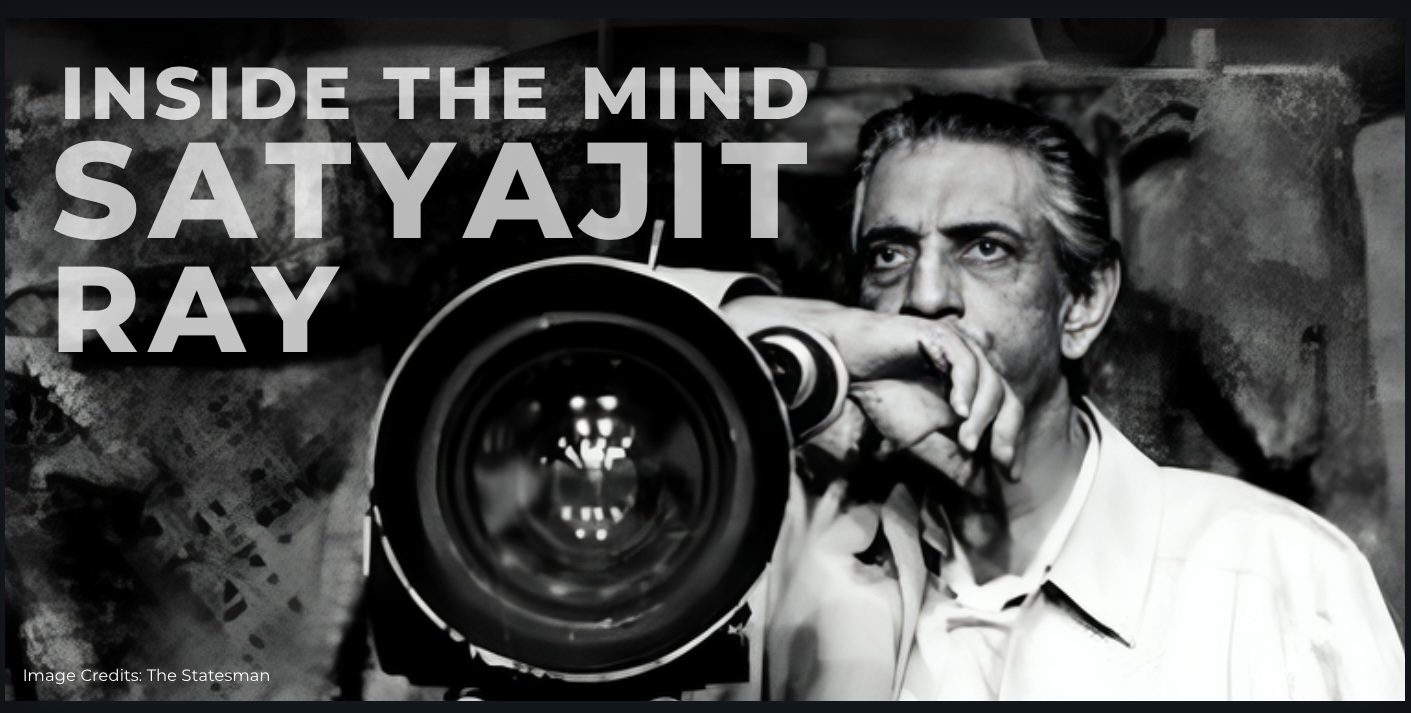
Introduction:
During a visit to Sodepur, Satyajit Ray saw a steamship drifting down the river Ganga. He was along the banks of the river when his father, Sukumar Ray, excitedly pointed out the ship leading to a foundational image that stuck with him through his years as a filmmaker. This moment became inspiration to several emotional and visual symbolisms in his movies. This scenery sparked curiosity and wonder that he inculcated into his movies over the years. Many of his films such as ‘Pather Panchali (1955)’, ‘Aparajito (1956)’ and ‘The Adversary (1970)’ have featured ship imagery, as a way to convey underlying layers of emotion and depth.
In his early days, before fame, Satyajit Ray co-wrote a script for Tagore’s Ghare Baire with his friend Harisadhan Das Gupta. When asked to make commercial changes by the producer, he refused to compromise the storyline. He placed emphasis on maintaining depth and quality to the story, a trait that set his films and stories apart even today. He did not believe in confining his stories to meet the larger audience but rather focused on making his stories rich in substance, complexity and resonance. His films featured a raw and unfiltered portrayal of human experiences, carrying a reverence and compassion for everyday life.
Life Brief:
Satyajit Ray was born on May 2nd 1921 to an affluent family in Kolkata. His father, Sukumar Ray, was a renowned author known for various literary works.Satyajit Ray initially trained to be a commercial artist and illustrator. He studied at Visva-Bharati University in Santiniketan, where he developed an interest in the legacy of Rabindranath Tagore.
He was inspired to become a film maker upon his meeting with the French director Jean Renoir and by the Italian film ‘Bicycle Thieves (1948)’. For his first film ‘Pather Panchali (1955)’ he sold his personal belongings in order to obtain the funding. This movie along with it sequels gained worldwide recognition for Indian cinema. In addition to film making he also wrote scripts, composed music and designed materials for publicity. He was also a writer of short stories and novel for children as well as young adults. Through his writing, he created memorable characters like detective Feluda and scientist Professor Shonku. His films continue to be honoured for their humanity, emotional depth and unique cinematic language.

Life Philosophy:
His film making style was greatly influenced by realism and admiration for life’s ordinary moments. He observed human nature and portrayed his characters with empathy and authenticity rather than exaggeration. He saw cinema as a mirror of reality. His films avoided the use of artificial elements, relying solely on natural lighting, real locations and naturalistic actors. This was done with an aim to reflect life’s daily rhythm. These films often explored social issues, traditions and human relationships, inviting viewer contemplation rather than providing a pre-defined conclusion.
His focus lay on the integrity of conveying the story rather than obtaining profits or recognition. He prioritised originality irrespective of social expectations and mass preferences. His talent lay in his ability to create emotionally harsh yet resonant films. He did not cater to industry expectations, instead focusing on truthful story telling. He sought to bring out the beauty within the ordinary.

Creative Work Dissection:
- The Apu Trilogy (Pather Panchali, Aparajito, Apur Sansar)
This trilogy was inspired by Bibhutibhushan Bandyopadhyay’s semi-autobiography. It follows the journey of a young boy named Apu. The movies showcase the endurance and resilience shown by Apu as he navigates rural life, poverty and other social challenges. This trilogy conveys the message that life is precious despite hardships.

2. Charulata (1964)
This movie takes inspiration from Rabindranath Tagore’s novel, Nashtanirh (The Broken Nest). Charulata follows the story of a lonely housewife during the pre-independence era in Bengal. Satyajit Ray was deeply touched by Tagore’s subtle emotional signals and feminine consciousness. The movie revolves around Charulata’s want for independence and her defiance against domestic constraints.

3. Jalsaghar (1958)

Jalsaghar (The Music Room) was inspired by a short story by Tarasankar Bandyopadhyay. The movie follows Bishwambhar Roy, a zamindar whose wealth has declined. He throws lavish musical recitals even as his fortunes depreciate. The story conveys a message of denial and delusion as Bishwambhar stubbornly refuses to accept his fate.

4. Agantuk (1991)
Satyajit Ray’s Agantuk (The Stranger) is inspired by his own short story. It explores themes of identity and the bridge between tradition and modernisation. The story centres Manmohan Mitra whose views and ideologies lead to him feeling alienated by his own family. It perfectly captures how social and cultural changes could lead to feelings of estrangement in one’s own home.

Actionable for Aspiring Filmmakers:
- Patient and Paced Storytelling:
Satyajit Ray was known for his unrushed and emotionally focused movies. His method prioritised conveying the message thoughtfully rather than just reaching an ending point. By doing so, the viewers are given time to absorb the density and depth of the story.
- Visual Storytelling and Symbolic Depth:
Satyajit Ray made use of elements like lighting, framing and symbolism to convey the complexity of his storylines. By mastering the art of utilising these elements, cinematic representation can be strengthened.
- Multi-Disciplinary Skills:
Besides filmmaking, Satyajit Ray was also skilled in writing, music composition and illustrations. Developing multi-field talents can enhance filmmaking and improve cinematic language.
- Balancing Tradition and Modernity:
Satyajit Ray’s movies provide a meeting-point for tradition and modernity. He skilfully weaves modern cinema into traditional storytelling to add emotional resonance to his films. Finding a balance between the two, enriches cinematic expression which sets apart films from the mainstream cinema.
Conclusion:
Satyajit Ray is an inspiration to those who have agenuine passion for films and storytelling. His films are rooted in culture and integrity. He motivates aspiring filmmakers to focus on emotionally rich and meaningful depiction rather than chasing commercial gains and profits. Young creators can learn the lessons of patience and strong creative belief through his films. His legacy continues to shine highlighting the beauty of simplicity and grace in films.