

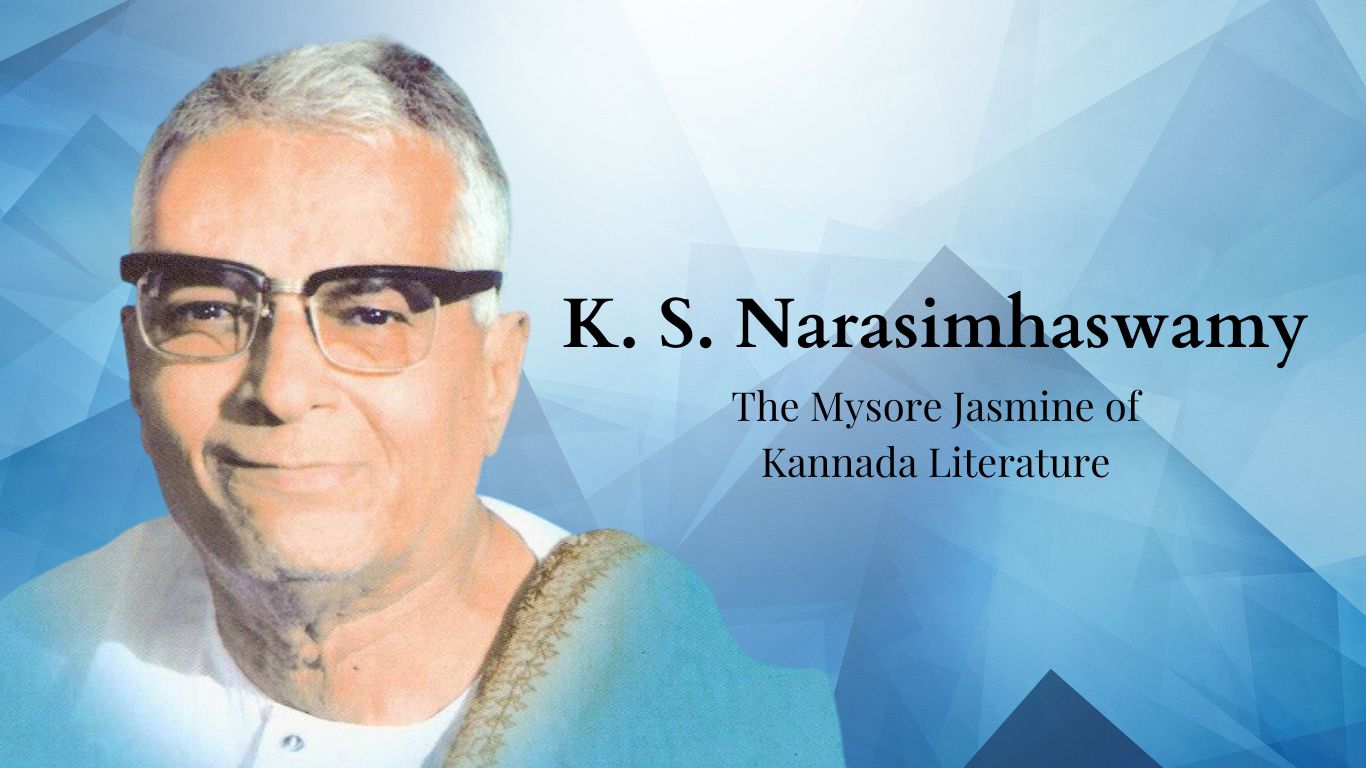
The world of poetry is filled with mystery. Poems are the veil that when penned down brings to notice a world that hides in the crevices of the reality we live in. Poems bring out expressions and perspectives that help one make their voice heard. The diversity in poetry is what makes it so cathartic and bewitching. But sadly, poetry wasn’t always this diverse or cathartic. Followed by a string of rules and regulations the poetry world was very very strict. But then there are always a few such poets who usher in a new genre by just expressing themselves however they wanted to. One such poet was K. S. Narasimhaswamy.
The Journey
Born in Kikkeri in the Mandya district of Karnataka on 26 January 1915 K. S. Narasimhaswamy was a prominent Indian poet who wrote in the Kannada language. In 1934 he enrolled in Central College in Bengaluru and successfully obtained a Bachelor of Arts degree. His marriage to Venkamma in Tiptur in 1936 is what set in motion his life as a poet.
His wife was his muse. She was the art and he was the artist. And his love for her was clearly visible in the poems he wrote about love and marital bliss. At a time when many writers were still busy writing about nature and the natural world, Narasimhaswamy found his peace in love. His works were highly inspired by Robert Burns, giving his writing style and technique a unique touch.
Apart from being a poet at heart, he was also a translator. He translated a lot of work during his time. Some of the major ones are- Media (1996), Robert Burns Kaviya Kelavu Premageetegalu (1997), and Kelavu Chinee Kavanagalu (1997). It is true that the true essence of literature can only be appreciated once it becomes accessible, and by being a translator Narasimhaswamy aided in this particular sphere.

Such ones do not just come once and leave;
‘It Happened This Way’
does the earth only momentarily turn heaven?
Her saying that he will come again is not untrue,
the rain, the grain, all life itself happens from them.
K. S. Narasimhaswamy
Translated by Madhav Ajjampur
He was part of the Navodaya movement in Kannada literature. Navodaya movement, also known as the renaissance in Kannada literature was a period in which many writers took it upon themselves to not only express but also nurture modern Kannada literature by translating many pieces of literature from English to Kannada. From poems and short stories to essays and novels, it encompassed everything. This period showed the influence of Western modernity, literature and education on Kannada literature.
Though he is an expert translator, his masterpiece is a collection of poems- Mysooru Mallige (1942). Owing to its huge popularity this collection has received more than thirty-two reprints. Apart from publishing a huge collection of poems and translating some works, he has also written many proses such as Maariya Kallu (1942), Upavana (1958), Damayanthi (1960), and Sirimallige (1990).

Afterword
Although his popular work made him stand out from the crowd he always remained rooted and was very down to earth. This quality is especially highlighted in his essay titled, Basavanagudiyalli (In Basavanagudi) when he decides to get down from a bus so that a couple can ride the bus together. He has received a lot of recognition and honour for his work. From Sahitya Akademi Award to the Asian prize for literature, he has bagged them all with his sheer talent and hopes to usher in a new era of Kannada literature.