

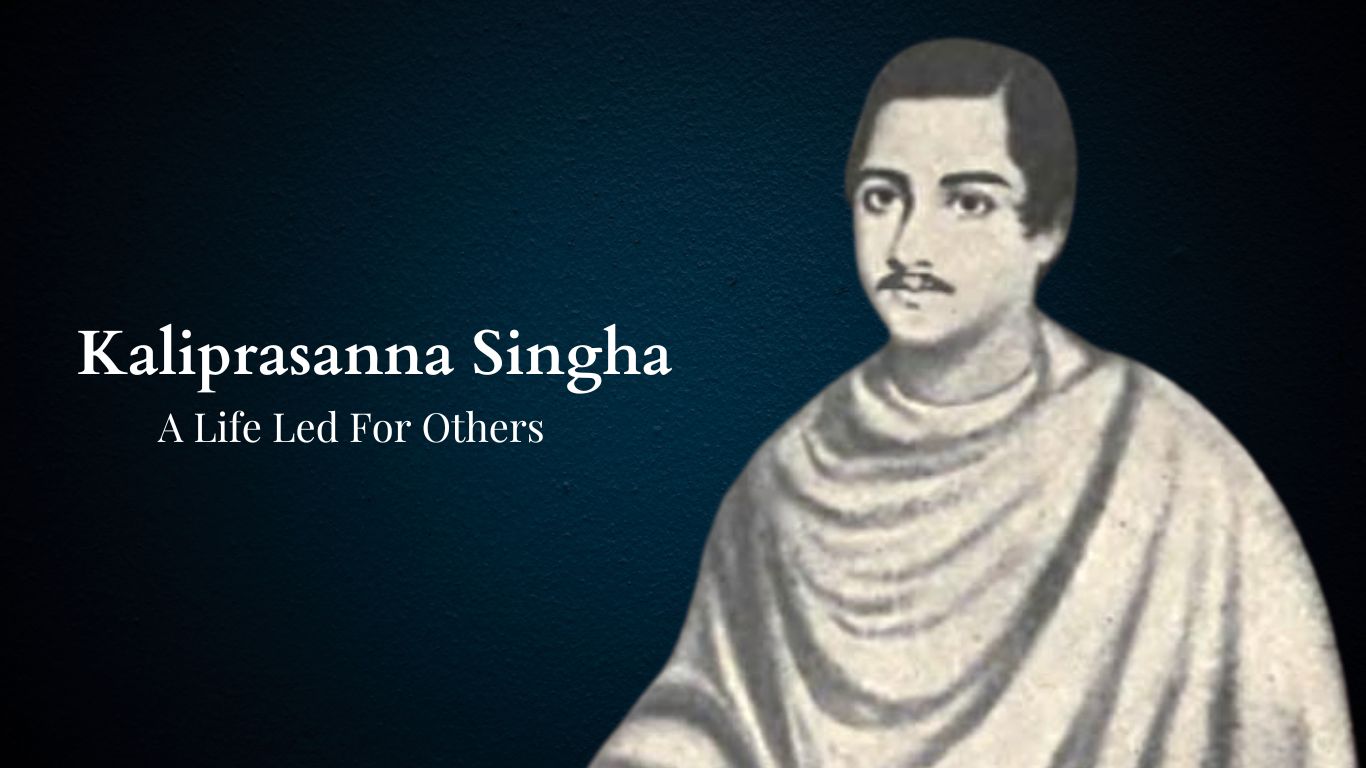
They say you haven’t truly lived your life if you have not lived it for someone else. In this world where following your dream and caring only about yourself is so easy, it is hard to truly be selfless. How many of us can actually give up our luxuries and ways of living just for the greater good? Not many. It’s easy to follow one dream which is yours, but it is indeed very hard to nurture those of millions. That’s exactly why Kaliprasanna Singha stand out in the crowd to this day.
Kaliprasanna Singha: Early Life
Although the exact date of his birth is debatable, according to the news published in Calcutta Courier his birthday is assumed to be somewhere near 23rd February 1840. Born to a family of zamindars, especially the renowned “Singha” family of Jorasanko, North Kolkata, he was born with a silver spoon in his mouth.
Later being known as an author, playwright and philanthropist, he was a very versatile man whose skills helped in uplifting the status of his community in the long run. Since a very young age, he caught the attention of Ishwarchandra Vidyasagar with his ability to mingle with elder associates and lead them towards recreational pursuits which involves the organisation of theatres. It was said that he had the ability to recall anything he saw or heard once.
Currently known as Presidency University, Singha was admitted to Hindu College which he left in 1857. Although he left college, he never really stopped his pursuit of knowledge as he continued to study and expand his knowledge in English, Bengali and Sanskrit at home.

Kaliprasanna Singha: Literary and Theatrical Journey
As an avid lover of literature and theatre, it comes as no surprise that his contributions to both Bengali literature and theatre are immense. At just the age of 15, he managed to establish Vidyotsahini Sabha. A platform dedicated to helping those who are interested in education, many eminent personalities such as Krishnadas Pal, Acharya Krishna Kamal Bhattacharya, Peari Chand Mitra, etc. were associated with it. He also established Vidyotsahini Mancha in 1857 at his own home. Being a versatile actor, Singha used to play the role of both female and male characters in dramas with ease.
His love for Bengali literature is just as deep as his love for theatre. After writing and editing several magazines like Vidyotsahini Patrika, Paridarshak, Sarvatattwa Prakashika, Bibidhartha Samgraha etc. he finally published his highly acclaimed book Hootum Pyanchar Naksha in 1862. Under the pseudonym Hootum Pyancha, Singha explored the tension that arose at that time within several areas of Bengali society. From the rise in conversions to Christianity to the ideologies that mid-19th century social reformers adopted in the name of the greater good, the entire book is a compilation of satirical social sketches.

Perhaps his greatest contribution to the world of Bengali literature is his translation of the Hindu epic, Mahabharata from Sanskrit to Bengali making it more accessible for the common men and women. He also translated the Bhagavad Gita into Bengali but it was published posthumously.
Kaliprasanna Singha: Social Work
A true people’s person, Kaliprasanna Singha, didn’t leave a single stone unturned as he did everything in his power to ensure the flourishing of his community in the long run. From distributing the Bengali translated copies of Mahabharata without charging a single rupee to buying the ownership of the magazine owned by Harish Chandra Mukherjee upon his death to prevent it from shutting down, when it came to contributing to the growth of his community, Singha was forever ready.
A big advocate of widow remarriage, when the Widow Remarriage Act was passed in 1856, Singha offered a sum of ₹1000 to every man who married a widow. When the Anglican Priest Rev. James Long of the Church Missionary Society was accused of sedition as his Bengali language play Nil Darpan, portrayed the European Indigo merchants in a bad light, it was Singha who paid his fine. From working as an honorary magistrate and Justice of Peace to serving as the Chief Presidency Magistrate of Calcutta to getting elected as a Municipal Commissioner for Calcutta, he made sure he was an active participant in the functioning of the society. He also provided financial support to many magazines and journals like Tattabodhini Patrika, Somprakash, Hindu Patriot, etc.
Kaliprasanna Singha: Legacy
Dying on 24th July 1870 at just the age of 30, Singha left such a huge legacy behind in such a short period of time that many fail to do even while living a long life. Although he was born to a family of zamindars he never stopped fighting the fight for the labourers who were forced into this zamindari system. Due to his helping nature, he did incur a lot of financial crises in the later years of his life and was deceived by many friends and relatives. Because of his down-to-earth nature, he served as a major inspiration for the lead character in Sunil Gangopadhyay’s famous Novel, Sei Somoy (Those Days).