

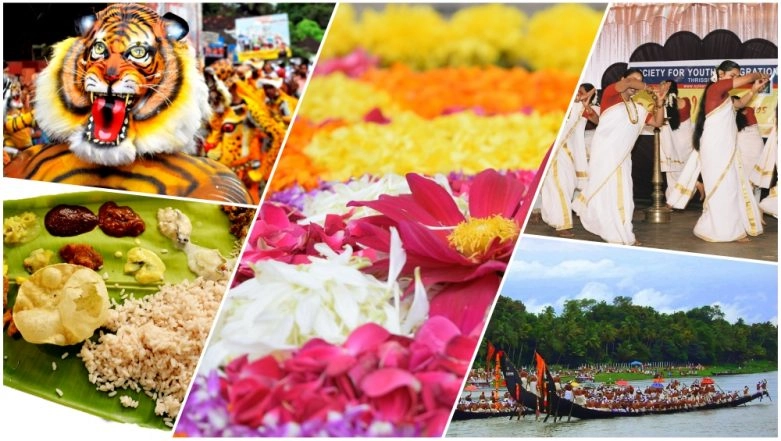
Let us start with an imaginative exercise. Picture that the monsoon rains have just ended in Kerala. The fields are green, the rivers are full and the air smells of wet earth and fresh harvest. It is the time of Onam, Kerala’s most loved festival, celebrated for ten days with pookkalam (flower carpets), vallam kali (snake boat races), dances, games and family gatherings. Now imagine sitting on the floor with hundreds of people, rich and poor, young and old, all eating together. In front of you is not a plate, but a shining green banana leaf. On it, one by one, dishes are served, salty, sour, spicy, sweet. By the end, your leaf looks like a rainbow of food. This is the Onam Sadya, the grand vegetarian feast of Onam.
But here’s the secret: Sadya is not just food. It is a story, a philosophy, a way of life, written not in words, but in rice, coconut milk and turmeric.
Beyond the Food: The Meaning of the Banana Leaf
At first glance, you may think, “Oh, it’s just a big meal.” But the Sadya is much more. Even the banana leaf has meaning. It is not just a plate. It is a symbol of fertility, nature and renewal. The leaf is wide, green and pure. My friend’s grandmother always sprinkled a little water on it before serving food, a gesture of both cleansing and respect. The leaf is also practical, it is antibacterial, aromatic and when the feast is over, it goes back to the soil, leaving nothing behind.
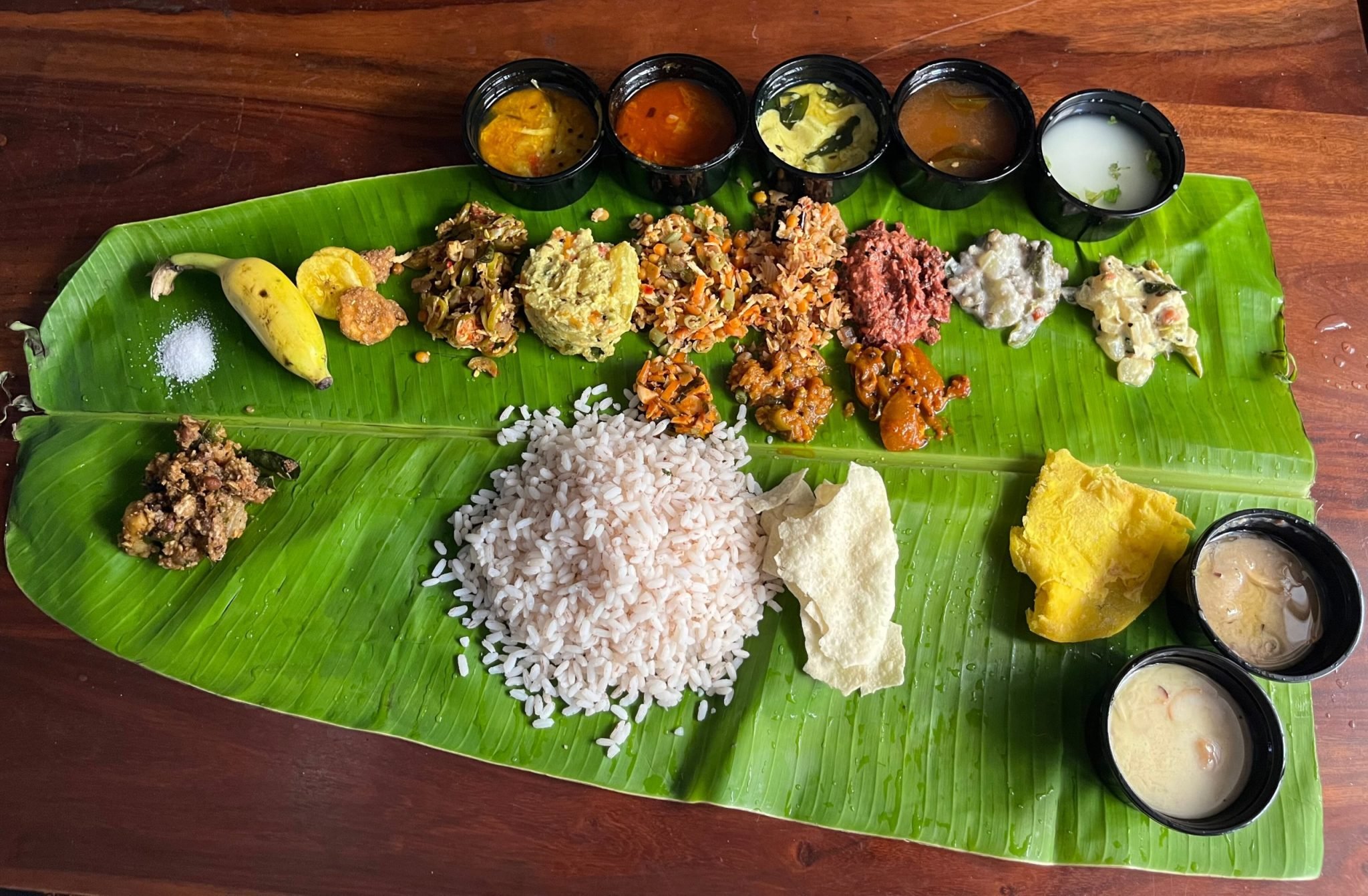
The way the leaf is placed matters too. The wider side faces you. Then, from left to right, dishes are added in a fixed order, almost like writing on a page. Salt first, then pickles, banana chips, dry vegetables, curries and finally, the sweet payasam. This order has been followed for generations. It is like a coded language, where each dish is a word and together, they create poetry.

The Choreography of Food
Think of the Sadya as a performance on the leaf. Every item has its place, every place has its logic.
- Salt comes first, as it is the base of taste, like the foundation of life.
- Then come pickles and papadam, sharp, crunchy, exciting.
- Next, dry vegetable dishes like avial (a mix of vegetables with coconut) and thoran (stir-fried with coconut) are served, both colourful and nourishing.
- In the middle arrive the curries, sambar, rasam, parippu, pulissery, flowing toward the rice. These represent the heart of the meal, the true sustenance.
- Finally, the meal ends with payasam, a sweet, creamy dessert, reminding us that life, no matter how bitter or spicy, should always end on a sweet note.
In Pallakad, kootu curry made with a few veggies and legumes is a must. While in Malabar , you may find pachadi with pineapple or beetroot. Every region has its touch, yet the sequence remains the same. The whole structure is like a journey: from the simplest taste (salt) to the fullness of food (curries) to the joy of dessert. It is not just cooking. It is philosophy served on a leaf.
Abundance on a Leaf
Onam comes after the harvest. The land has given its best and the people celebrate with gratitude. The Sadya mirrors this abundance. It is not a meal of one or two items. It is a feast of twenty to thirty dishes! Crispy banana chips, fiery mango pickle, gentle olan made with coconut milk, tangy rasam, soothing yogurt curries and finally, the rich payasam. Some families even serve two or three types of payasam, ada pradhaman, pal payasam, semiya payasam, each with its own unique taste.
The message is clear: “We have plenty. And in our plenty, there is always room for you.” This is why Sadya is not meant to be finished by one person. It is meant to be shared. It is a symbol of generosity. In a world where many still go hungry, Sadya reminds us: food is most meaningful when shared with others.
Equality at the Feast
Perhaps the most beautiful part of the Sadya is that everyone eats together. There are no separate tables for the rich, no special plates for the powerful. Everyone sits on the floor, shoulder to shoulder. Food is served with humility, from the left side, by volunteers or family members. This tradition connects to the story of King Mahabali, the beloved ruler of Kerala, whose reign was known for justice and equality. On Onam, when Mahabali is believed to visit his people, the Sadya becomes a living reminder of his values.
Caste, class, status, all vanish before the banana leaf. For a few hours, everyone is simply human, eating together. What other meal in the world achieves this so silently, so beautifully?

Wisdom of Ecology
Long before words like “eco-friendly” and “sustainable” became popular, the Sadya was already practising them. Every dish is made from local, seasonal ingredients like yams, gourds, pumpkins, cucumbers and of course, coconut in all its forms. Nothing is imported, nothing is out of season. The banana leaf itself is biodegradable. Even the order of dishes follows principles of Ayurveda, ensuring balance for body and mind. When you eat a Sadya, you are not only eating food, you are tasting ecological wisdom. It whispers that culture and nature are not separate but one fabric.
A Feast for the Senses
Sadya is not only about filling the stomach. It is about beauty. Look closely at a Sadya and you will see art.
- Bright yellow parippu, fiery red pickles, green thorans, brown olan, white payasam. Together they form a palette as colourful as a temple mural.
- Taste too is balanced with all the six flavours of Ayurveda, sweet, sour, salty, bitter, pungent, astringent.
- No one dish dominates. They work together, like musical notes in a raga, like colours in a mandala.
The Sadya is not random. It is composed. To eat it is to participate in an aesthetic ritual, where nourishment and beauty become one. Today, the Sadya has travelled far beyond Kerala. In Dubai, London, New York, the Malayali community celebrates Onam with Sadya. Restaurants may serve it on porcelain plates instead of banana leaves and some ingredients may be replaced, but the spirit remains. In fact, many non-Malayalis too look forward to Onam Sadya festivals in cities across India and abroad. It has become Kerala’s cultural ambassador, telling the world a story of abundance and equality.
Why the Sadya Still Matters
In our world of fast food and instant meals, the Sadya stands apart. It asks us to slow down. To sit on the floor. To eat together. To taste carefully. To value not just the food, but the moment. It is Kerala’s cultural gift to the world, a feast that feeds the stomach, yes, but more importantly, feeds the soul.
A Poem on a Leaf
The Onam Sadya is not just cuisine, it is Kerala’s civilizational philosophy served on a leaf. Each grain of rice, each ladle of sambar, each spoonful of payasam is part of a carefully arranged sentence. Together, they compose a cultural poem that says:
Life is abundance. Life is equality. Life is rooted in nature. And above all life is meant to be shared.
So, when you next sit before a banana leaf during Onam, pause. Look beyond the dishes. Listen to the silence between servings. You are not just eating, you are reading. The Sadya is Kerala’s civilizational philosophy, served not in ink, but in the language of food, community and the earth, turmeric and coconut milk. It tells us:
The leaf may be folded and discarded, but its message lingers, fragrant and eternal. A feast, yes, but also a language, a poetic promise, our culture, our India.
Check out our article on Role of Rituals and Festivals in Indian culture here!