

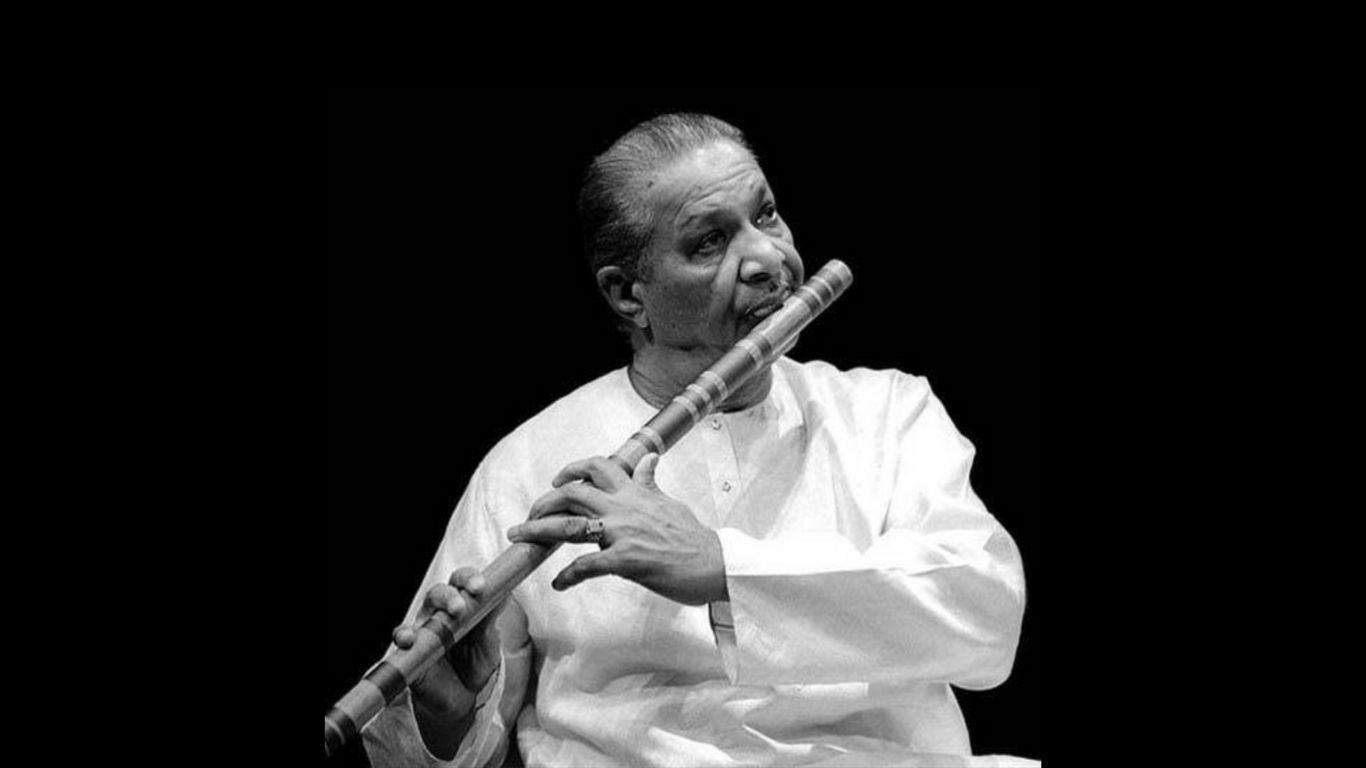
Pandit Hariprasad Chaurasia, one of the most legendary musicians to have hailed from India, made a name not only for himself but also for the art of playing the flute. He has drawn both national and international acclaim throughout his career, extending and expanding the reach of Hindustani Classical music to great heights. His gifts of innovations introduced new styles of flute-playing which continue to hold a massive influence on flautists today.
Looking at his extraordinary talent, one would naturally assume that he came from a family of musicians. But his interest in music was all his own, so was everything that he learnt out of his sheer dedication towards it. Born on July 1, 1938, Chaurasia lost his mother when he was quite young. His father was a wrestler and wanted his son to take up the sport too. Chaurasia, however, was interested in music, a field that stood poles apart from wrestling. As a young boy, he would secretly attend music lessons at his friend’s place, and at 15, he started training under his neighbour. Later, he made the renowned flute player, Pt. Bholanath Prasanna, his Guru.
He began working as a composer and performer with All India Radio in 1957 in Cuttack, Odisha. Three years later, he transferred to Bombay which helped open more doors of opportunities for him. There he also met Annapurna Devi, a classical music teacher, and Bass-Sitar player. She agreed to take him in as her disciple, and Chaurasia showed his devotion, like he always did, to his Guru by surrendering to them like his God.
“The flute is the symbol of spiritual call, the call of divine love.”
It was also in Bombay that he connected with Pt. Shiv Kumar Sharma. So began the partnership of Shiv-Hari in 1967 when they began working on Bollywood films together. They created many popular songs and composed for films like Silsila, Chandni, and Darr. Hariprasad Chaurasia also collaborated with Bhubaneshwar Mishra, a classical violin player. ‘Bhubhan-Hari’ would go on to compose music for many Odia movies.

By then Chaurasia’s skills had already achieved great appreciation and acclaim, on both national and international fronts. Shiv-Hari had composed ‘Call of the Valley’, also featuring guitarist Brij Bhushan Kabra. The album’s instrumental compositions follow a day in the life of a shepherd from Kashmir. Released in 1967, it has been considered an important influence in introducing Indian music to the west. From George Harrison to Bob Dylan, many celebrated musicians have been known fans of the album. Chaurasia also collaborated in 1968 with the famed rock band, The Beatles for their song, ‘The Inner Light’.
For all his accomplishments and contributions, flute maestro Hariprasad Chaurasia has been awarded Padma Bhushan (1992), Padma Vibhushan (2000), Sangeet Natak Academy (1984), National Eminence Award, and the Akshaya Samman (2009) among many others. The two places, Odisha and Bombay, where his career had marked milestones, now hold music institutions established by him.