


Reduva, a pidgin term for radio, is a short film set in a rural Haryana. Written and produced by Pankaj Rathee, the film tells the story of an old man trying to live his post-retirement days in peace and remembrance of his late wife. His constant pursuit of peace is disrupted time and again by none other than his own son.
Plot: Radio
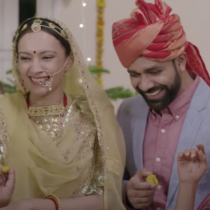
Directed by Vipin Malawat, Reduva opens with a scene of a wedding ritual followed by the old man, then young, receiving a gift from his wife, a radio. The film shifts to the present, where the old man is listening to the same song from his wedding night on the radio – a gift from his wife. He is seen to be having fun listening to music, playing with a street pup, and feeding him some food.
However, this personal moment is soon disrupted by a harsh comment from his daughter-in-law pointing at the struggling economic conditions of the family. While he is still processing this, he gets to know another infuriating news of his son getting in trouble. The film shifts to the introduction of the son. He is getting his injured forehead treated by the local village doctor. The doctor advises the old man to put the son into a rehabilitation center to fix his alcohol addiction.
The old man is constantly found listening to the radio, the particular song from his wedding night in particular in the quiet. He is out of money and waiting to receive his pension amount. He is not able to get the local cigarettes for credit. Moreover, the daughter-in-law refuses to feed him lunch because she wants more share of the pension to run the house. When the daughter-in-law complains about her struggling financial situation to her husband, she is found to be a victim of domestic abuse. The son represents most of the violence and trouble in the film. He even proceeds to fight with his father and break the radio irreparable. The violence prevails throughout the film.

Women In The Film
The short film portrays a sharp, accurate, and unsettling condition of women in contemporary Indian society, both urban and rural, at the mercy of patriarchy. Most rural Indian families don’t let women work formal jobs. Moreover, as seen throughout the film, in some villages, they’re even confined behind the “purdah” in front of men other than the husband of the woman. While the daughter-in-law is shown to be rude towards the protagonist, the old man, it is equally important to realize where her rudeness is coming from.
Placing it in the very manifolds of patriarchal society, she is a passive character. She lacks agency, and there is almost no space to exercise any active voice she might have in her. Her comment about the responsibilities she has running the house highlights the invisible labor of women. The labor which is required equally for any healthy life. She is found fully dependent on her husband to bring home food and money.
Additionally, the painful-to-watch incident of domestic violence comments on the reality of women’s lives. Today when domestic violence is a punishable crime, domestic violence is as natural as shown in the film. The way she already expects her husband to beat her for complaining prompts the viewer to question and engage with the question employed by Pankaj Rathee, “Where lies the agency of the woman?”
Beyond the Dialogues
Reduva, the short film is an attachment story of an old man with his cherished gift, a radio. Amidst many troubles that he meets – financial struggles and a drunkard son, he is found at peace and solace when he is with his radio. The radio, quite literally, is the only source of happiness in his life. His first scene begins with a radio playing. He falls asleep to its music and turns it on whenever he feels sad, such as when he cannot buy local cigarettes. His relationship with the music and the radio is a perpetual way of living for him in his old age. He is contemptuous and at peace reminiscing about his wife listening to the music from his wedding night.
However, there is also a constant noise of trouble, always brought in through his son. He is either fighting in the streets, or the worst, breaking his radio, leaving him sad . When the radio is broken, the static noise represents the trouble that has outbroken all of a sudden. The clever audio effects prompt the viewers to connect the physical nuisance with the familiar nuisance of broken electronic devices. The following silence serves as a metaphor for the silence that has been brought into the old man’s life.
Summing Up Pankaj Rathee’s Reduva
While the viewers may expect a positive outcome of this rather saddening situation of the old man, disappointingly, it only gets worse. Pankaj Rathee’s film portrays not only a natural but also a real story of a regular rural household. In real life, troublemakers don’t turn good in one day. Instead, they only bring more trouble. And, the people who suffer are always the weaker section of society – women and the old in this case. The ending of Reduva is a sharp portrayal of Indian rural and general society and does not deliver false hopes for the viewers.