
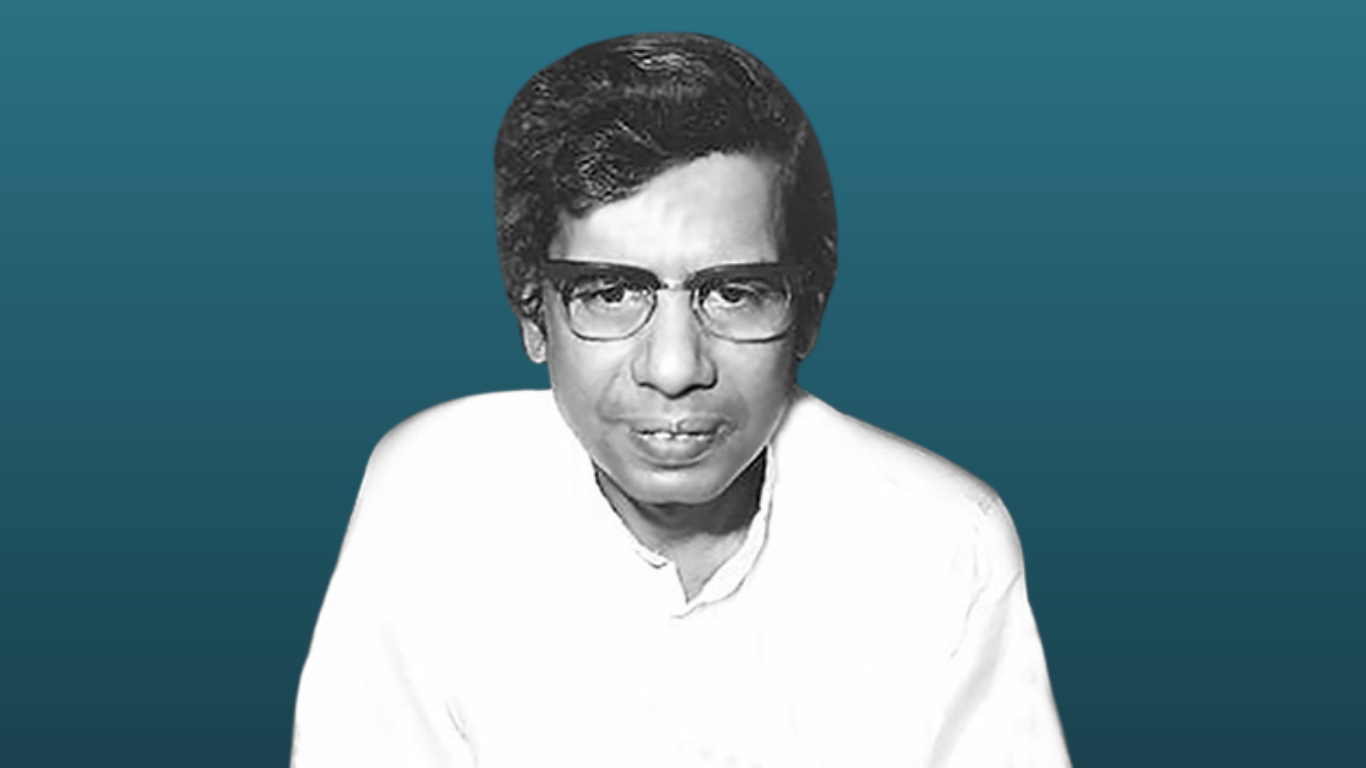
Hindi Literature is the quintessence of grace and treasure. The harbingers of Hindi literature like Premchand, Mahadevi Verma, Jaishankar Prasad, Phanishwar Nath Renu, etc have produced some of the finest works. In this regard, Phanishwar Nath Renu has contributed significantly to Hindi literature, especially as the voice of Rural India. If Premchand was known as ‘Qamal Ka Sipahi’, Renu was hailed as Chronicler of the oppressed and the poor. The revolutionary characteristic of Renu marked the post-Premchand era. Through the genre of ‘Aanchalik Upanyas’, that is regional novels, Renu incorporated the regional voices into the mainstream Hindi literature.
A Biography of Renu and the Revolutionary Roots in Him
Phanishwar Nath Renu was born on 4th March, 1921, in the small district of Purnia, Bihar. He received his primary education in Bihar’s Araria and Forbesganj. He passed his matriculation from the Viratnagar Adarsh Vidyalaya, Viratnagar, Nepal and Intermediate from Kashi Hindu Vishwavidyalaya in 1942.
The author lived through the era of the freedom struggle of India. This time period was marked with waves of revolutions and developments. Renu hadn’t distanced himself from the much turbulence of this period, but actively participated in most of them. He lived through the Quit India Movement and also the Nepali Revolutionary struggle. Infact, Renu had also participated in the fight against the dictatorship in Nepal, and was involved in the attempts of establishing democracy in the country.
Amidst the socio-political and economic trends of India and the neighbouring countries, Renu established himself as a revolutionary thinker and writer. His in-depth study of rural India is more poignant than realised. His innumerable works vividly capture the plethora of changes that were igniting in rural India during the independence and the drafting of the constitution. The backwardness of the farmers, the poverty in his state home Bihar, and the lives of the Dalit Bahujan and Adivasis were subjectively portrayed in his works.

Subverting the Norms and Hierarchies
The Khadi Boli of Hindi was given the status of language. It was the language of the elites, whereas the polyphony of rural India was completely disregarded. Phanishwar Nath Renu’s exceptional subversion of the use of Khadi Boli in his literature is applaudable. His use of the local flavoured Hindi language instead of Khadi Boli, created an intimate relationship with his readers and rural folk. He played with the plurality of the languages and gave the language of the folk its due representation. Most of the time, his paragraphs were imbued with six to seven languages of rural India.
His works are brimmed with the rampant problems of the lopsided ownership, the rich and poor gap, between the upper castes and the lower castes. As a member of the lower caste community, he gave voice to his community by producing literature with landless farmers and lower caste as protagonists.

Renu is known as the leading proponent of Hindi Literature after Premchand. His literature must be remembered for the deep political lines, the complex social realities, casteism, class hierarchies and injustices.
His Literary Works and Achievements
Some of Phanishwar Nath Renu’s novels are Maila Anchal, Parti Parikatha, Juloos, Deerghtapa, Kitne Chaurahe and Paltu Babu Road. Amongst all the works, Maila Anchal (1954) is his masterpiece and considered the second best after Premchand’s Godaan (1936). He was also awarded the Padma Shri for Maila Anchal. Some of Phanishwar Nath Renu’s short stories are Maare Gaye Gulfam, Ek Adim Ratri Ki Mehak, Lal Pan Ki Begum Panchlight, Thes Samvadiya, etc. Some of the few collections of stories include Thumri Agnikhor, and Acche Aadmi. His short story, ‘Maare Gaye Gulfam’, was also adapted into a 1966 film, Teesri Kasam. He also wrote the dialogues for this movie. His short story ‘Panchlight’ was made into a TV short film.
Phanishwar Nath Renu left us on 11th April 1977.