
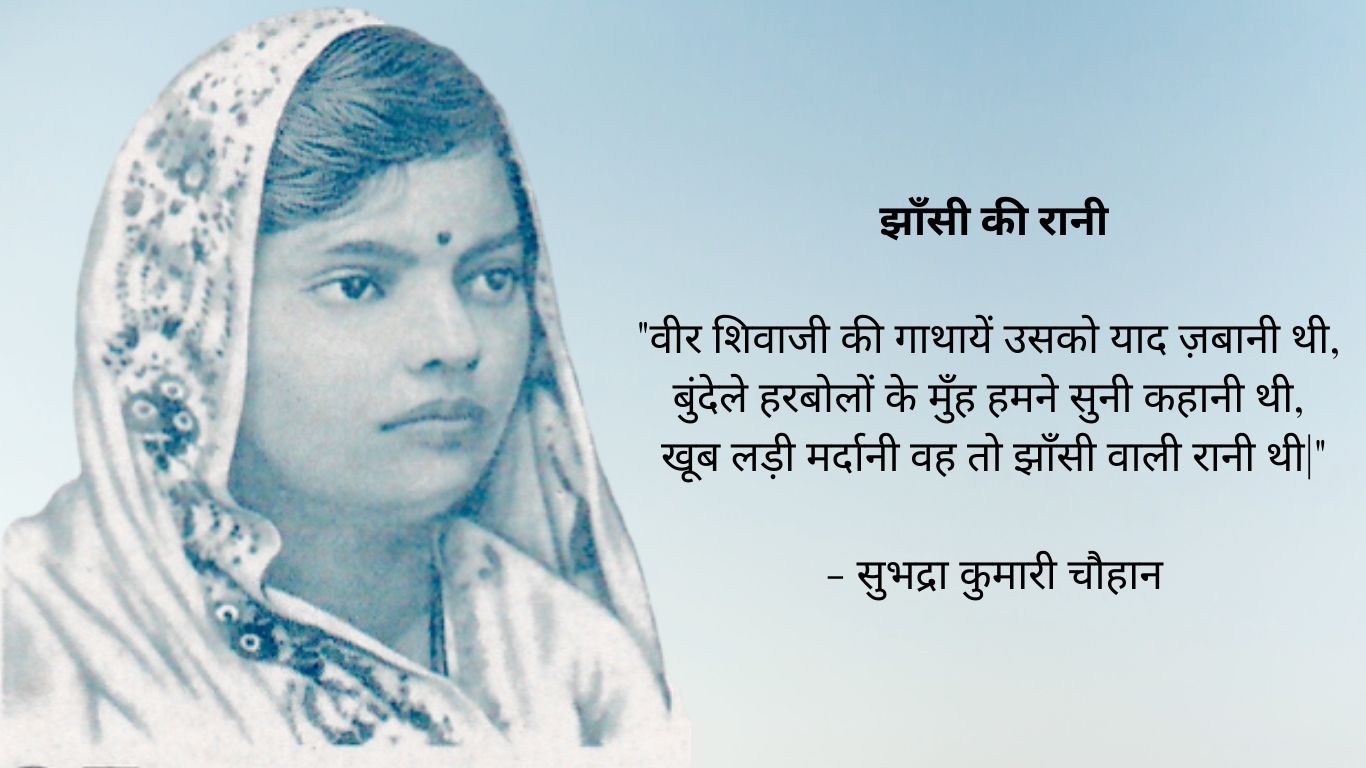
The lines that immortalised the life of Rani Lakshmibai, the Queen of Jhansi–“Khoob Ladi Mardani, Woh toh Jhansi wali Rani Thi”– also immortalised the poet who wrote them. Subhadra Kumari Chauhan, the writer of the pre-independence era has her name etched in the memory of many for her contributions to Hindi Literature. However, she had more to give than the words from her pen– a progressive and courageous approach towards freedom and its many facets.
Born on 16 August 1904 into a family of zamindars, in a village in Allahabad, Subhadra Kumari Chauhan began writing early on. It is said that she was so enthusiastic about writing that she’d write lines while traveling in a horse cart on her way to school. A prodigy, she wrote her first poem at the age of nine. She was also friends with the famous poet Mahadevi Verma in her school and the two are said to have spent time penning verses together.
At the age of 15 and having finished her senior secondary school, she married Lakshman Singh Chauhan who was part of many social reform movements against the system of dowry and the practice of keeping a ghoonghat or purdah (veil) enforced on women. Subhadra Chauhan gave up on wearing the veil in her new home, despite the uproar that the decision must have garnered in her traditional family.
राखी की चुनौती
मेरा बंधु माँ की पुकारों को सुनकर
के तैयार हो जेलख़ाने गया है।
छीनी हुई माँ की स्वाधीनता को
वह ज़ालिम के घर में से लाने गया है॥
सुभद्रा कुमारी चौहान
Her rebellion did not end there, for she joined the Non-Cooperation Movement in 1921 and even led the Jhanda (Flag) Satyagraha two years later. She was arrested in 1923 when she was pregnant with her first child, the reason why she was also released in a few month’s time. Her spirits not dampened by this occurrence, she continued with her participation in the freedom struggle, while also writing poems and stories that touched subjects of gender and caste, dowry, class inequality, etc.

In 1942, she participated in the Quit India Movement, during which time her husband was arrested and she moved to Bombay with her five children. Managing the whole household alone, she too was arrested eventually, for the second time, by the British forces. It was because of a life-threatening health condition that she was let out a few months later. In 1946, she was once again elected in the Bihar Legislative assembly having previously been elected in 1936.
Throughout these years of the political and social flux of the independence struggle, Subhadra Kumari Chauhan never let go of her writing. She wrote over 88 poems and 46 short stories. The collection called Mukul published in 1930 contained her most famous poem, ‘Jhansi Ki Rani’. Her other popular works included ‘Jallianwala Bagh mein Vasant’, ‘Veeron Ka Kaisa Ho Basant’, ‘Rakhi Ki Chunauti’, and more.

झाँसी की रानी
चमक उठी सन सत्तावन में, वह तलवार पुरानी थी,
बुंदेले हरबोलों के मुँह हमने सुनी कहानी थी,
खूब लड़ी मर्दानी वह तो झाँसी वाली रानी थी॥
सुभद्रा कुमारी चौहान
In one incident, Subhadra Chauhan’s progressive ideals were put to practice when she attended the wedding of her domestic help’s daughter and assimilated with all the people there, despite the reservations of upper-caste observers that she would be ‘polluted’ by sharing a meal with them. Another incident that became the talk of the town was when she supported her daughter, Sudha’s marriage to the legendary writer Premchand’s son, which was to be an inter-caste communion.
However, the writer’s aspirations to support the building of India post-Independence and Partition were tragically left unsettled when a month after Mahatma Gandhi’s assassination, she too lost her life in an accident on her way back from an assembly session in 1948. However, despite leaving the world at the early age of 44, Subhadra Kumari Chauhan led a life full of strength and courage which she put to full effect during the very crucial climate of the social and political evolution of India.
वीरों का कैसा हो वसंत ?
कह दे अतीत अब मौन त्याग,
लंके, तुझमें क्यों लगी आग ?
ऐ कुरुक्षेत्र! अब जाग, जाग,
बतला अपने अनुभव अनंत,
वीरों का कैसा हो वसंत ?
सुभद्रा कुमारी चौहान