

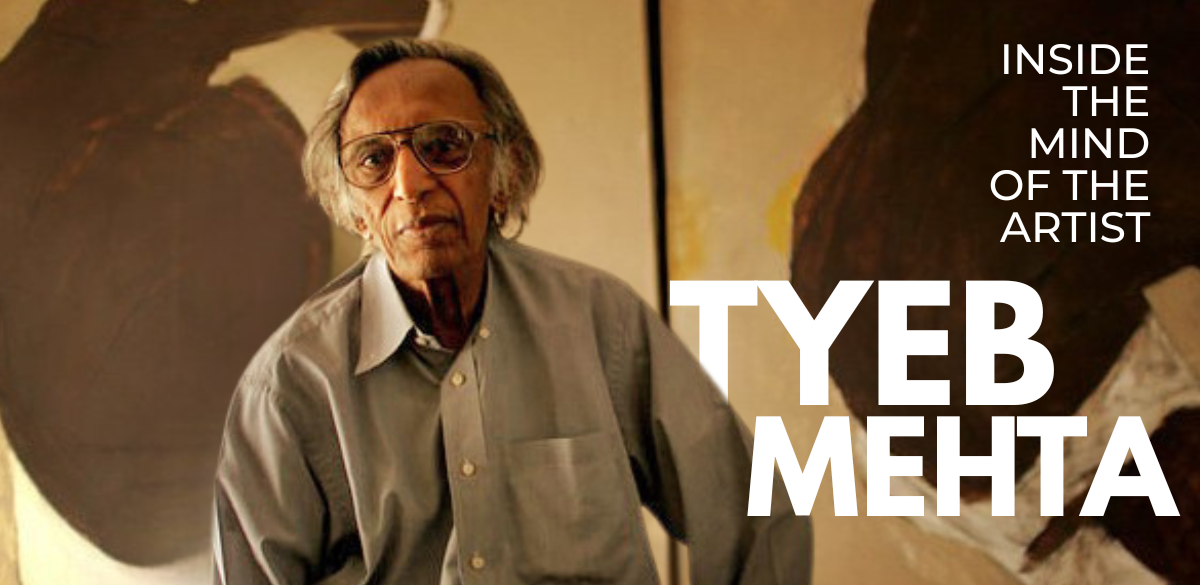
Tyeb Mehta’s art was largely influenced by a traumatic event he encountered back in 1947 during the partition riots. Living in Mumbai at the time, he witnessed a man being stoned to death by a mob. This scene would go on to haunt him and become the primary inspiration for his art pieces. The shocking act encouraged him to move away from traditional art figures towards more expressionist, vivid styles of depiction.
Tyeb Mehta’s art features motifs such as the falling figure, depicting the helplessness and suffering from his experience. His art combines disturbing elements as he aims to convey not just events but also the emotions of people when surrounded by violence and despair. His paintings became a voice of silent rebellion and disagreement as they portrayed the overwhelming stages that people go through when caught in emotionally dense situations. His art style is complex with sentimental depth as he combines Western influences and Indian themes to create universally resonant art. His work provides insight into the horrors of the partition and the unrest that followed independence. They serve as a powerful window into the past and a reflection of how far we’ve come as a community.

Tyeb Mehta’s life:
Tyeb Mehta was born on July 26th, 1925, in Kapadvanj, Gujarat, before his family moved to Mumbai. Growing up he was exposed to different cultures and a diverse urban environment. Initially he began his creative journey as a film editor and was later drawn to visual art. His newfound interest led him to graduate from the Sir J.J. School of Art in 1952. He went forth to become a member of the Progressive Artists’ Group alongside influential contemporaries such as F.N. Souza, S.H. Raza and M.F. Husain. His career found international success in London, New York and at Santiniketan, each playing a significant role in shaping his art style.
His work has also gained recognition in foreign exhibitions earning him numerous prestigious awards, including the Rockefeller Fund Scholarship. Apart from this he has also received the Kalidas Samman, Lalit Kala Akademi Gold Medal, Dayawati Modi Foundation award and the Padma Bhushan in 2007. His art has found its place in numerous prestigious collections around the world. His three-paneled work, ‘Celebration’, marked a major event for Indian art’s global emergence. Tyeb Mehta’s art continues to influence multiple artists today.

Life and Art philosophy:
Drawing inspiration from real life situations and conditions during the partition of India, Tyeb Mehta’s work centred on emotional expression with human suffering, violence and endurance. He believed that art is a reflection of personal and shared experiences that evolves from understanding the external world to understanding ones-self. His ideology was that an artist matures through his paintings as they convey real world circumstances and emotions.
His motifs symbolize powerlessness, endurance and the human struggle against societal and existential restrictions. The use of minimalistic forms, flat colours and dramatic diagonal divisions highlighted physical and psychological conflict. His work forms the bridge between modern and traditional art styles, taking inspiration from the Indian culture and representing them with a modernistic approach. Although his images appear violent, they are supported by a desire for non-violence and peace.

Artwork Dissection:
1. The Diagonal Series:
This series was created after an era of personal struggles as well as external political and social chaos. The diagonal across the canvas symbolizes division, conflict and turmoil. This series reflects a fundamental turn in Tyeb Mehta’s style to minimalism and abstraction.

2. Falling figures:
The recurring motif of falling figures represents the distress caused to Tyeb Mehta due to his memories from the partition. The suspended figures depict a state of limbo-a state between freedom and captivity, hope and despair, salvation and helplessness. These figures paint a metaphor of human vulnerability and resilience.


3. Gesture:
This painting utilizes human hand and body language to convey emotional complexity. He makes use of monochrome flat colours and physical gestures to convey tension, pain or defiance. This painting is proof of Tyeb Mehta’s interest in the silent language of the human body.

4. The Rickshaw Puller:
This piece is evidence of Tyeb Mehta’s compassion for the underprivileged and the brutality of urban manual labour. In order to highlight fatigue and resiliency, the rickshaw puller is depicted as a thin, exhausted figure with a muted color scheme. By bringing attention to societal injustices and human perseverance, he aimed to elevate the struggles of common people.

Inspiration for Aspiring Artists:
- Be Committed and Resilient:
Despite suffering a near-fatal cardiac arrest, Tyeb Mehta continued to practice and create his art. This is an important valuable lesson for aspiring artists. It goes to show that dedication can go a long way in your journey of success.
- Individuality and Authenticity:
Tyeb Mehta sought inspiration from Western modernism as well as Indian traditions but kept his art authentic and unique. The lesson we can learn is to seek inspiration from various sources while compiling them together to create your own, one-of-a-kind art work.
- Embrace Solitude and the Power of Reflection:
Solitude and deep reflection have greatly inspired Tyeb Mehta’s artwork adding mystery, depth and gravity to each piece. When artists learn to utilize these tools to their advantage, they unlock the secret to create truly moving and heart-touching paintings.
- Draw Inspiration from Real Life Experience:
Most of Tyeb Mehta’s paintings are inspired from real life events and circumstances. He captures the emotions and sentiments of those experiences through his paintings. He teaches young painters to find meaning and depth behind every situation and utilize it as inspiration for a masterpiece.
- Find your own unique form of expression :
Tyeb Mehta’s art features a unique and personalized method of expression. His paintings serve as encouragement for young artists to find their own ways to convey a message rather than going by the book. His work is proof that art isn’t a one size fits all but instead a language that connects people sharing the same hopes and aspirations, irrespective of how they convey these emotions.
Tyeb Mehta is known for creating a unique visual language characterized by strong lines, striking contrasts and emotionally charged compositions that combine modernist abstraction with Indian themes. His work, which is rooted in both individual and societal pain, strikes a balance between expressionism and minimalism. His signature diagonal technique cuts across paintings to represent psychological strain and division. Through limited palettes and reduced forms, he conveys agony, resilience and anguish, achieving emotional depth within abstraction.