

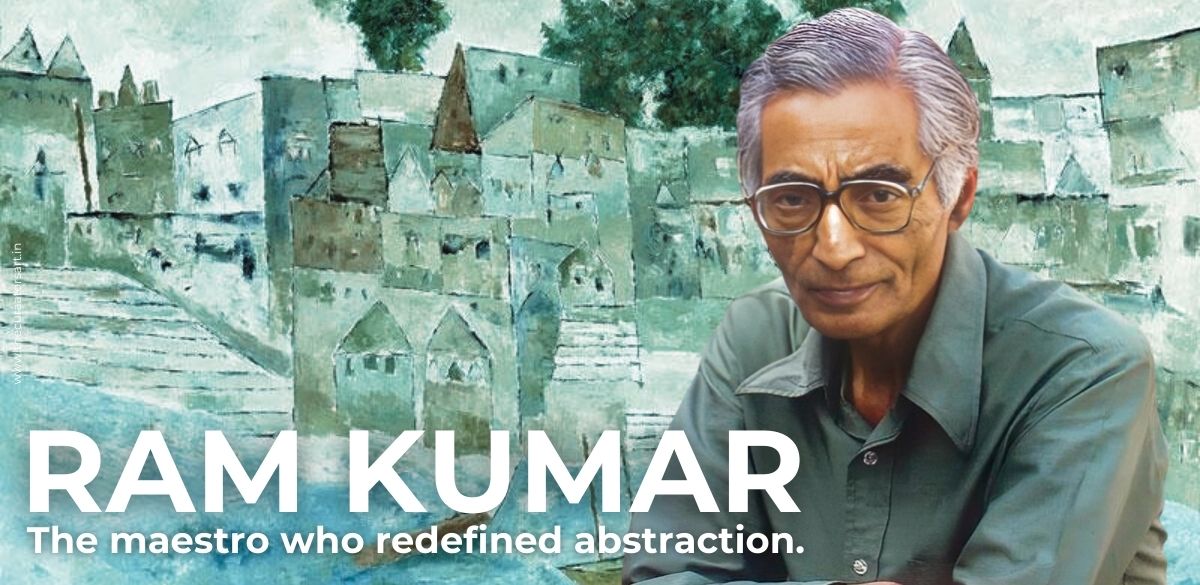
From figurative to abstraction, Ram Kumar, a luminary in India’s artistic cosmos, is a beacon of inspiration, revolutionising the canvas with his abstract strokes. Born in 1924, Ram Kumar’s journey from the corridors of academia to the bustling street of Paris and finally to the serene landscapes of Varanasi captures a profound evolution in both his art style and thematic preoccupations.
Ram Kumar was drawn into the art world due to a chance encounter with an exhibition at the Sarada Ukil School of Art while pursuing his Master’s in Economics at St Stephen’s College in 1945. He enrolled in evening classes at the art school under the guidance of artist Sailoz Mookherjea. Kumar started to hone his skills in still-life portrait painting, gradually transitioning to capture the urban decay and human condition of Delhi and Shimla through his paintings. During his formative years, Kumar’s art reflected a vibrant energy, often depicting scenes of everyday life juxtaposed with deeper existential themes. His works, such as “Why Can’t I Sleep” and “Oppression”, reflected the underlying social and political currents shaping post-independence India.
In 1948, Ram Kumar’s artistic journey took a significant turn when he joined a Hindi daily newspaper as a journalist trainee and crossed paths with artist J. Swaminathan. This encounter solidified his commitment to art, and began a lifelong friendship with fellow artists such as S.H Raza, F.N. Souza and K.H.Ara. The year 1949 witnessed Ram Kumar’s first solo exhibition in Shimla, where his paintings caught the eye of Dr Zakir Hussain, the then Vice-Chancellor of Jamia Millia Islamia University. Inspired by the early success, Kumar embarked on a journey of artistic enlightenment to Paris.
With its rich cultural tapestry, Paris was a crucible for Kumar’s artistic evolution. Under the tutelage of renowned artist Andre Lhote, Kumar delved into the work of lines, curves and colours, imbuing his works with a newfound dynamism inspired by the works of radicals like Louis Aragon and Roger Garaudy, as well as encounters with luminaries like Pablo Neruda, Kumar’s art began to reflect a deeper engagement with human emotions and societal realities. The years spent in Paris were transformative for Kumar, artistically and ideologically. His encounters with the works of Courbet, Rouault, Kathe Kollwits and Edward Hopper instilled in him a deep appreciation and sensitivity to the human experience, which would manifest in his later works.

When he returned to India, Kumar was drawn to the ancient city of Varanasi, where he encountered a land brimming with spiritual fervour and existential angst. The stark contrast between the city’s vibrant rituals and its silent decaying structures became a recurring motif in Kumar’s art.

The 1960s marked a watershed moment in Kumar’s artistic career as he transitioned from figurative to abstract expressionism. His “Grey Period” changed from vivid colours to muted tones reflecting the sad realities of human suffering and mortality. His cityscapes of Varanasi, rendered in Cubist aerial views, symbolised the existential angst that permeated his work. Kumar’s later works continued to explore Varanasi’s spiritual and existential dimensions, albeit with a newfound sense of transcendence. His “Benaras Series”, characterised by ethereal blues and a sense of collective spirituality, captured the city’s timeless allure while evoking a deep sense of human emotion and longing.

In retrospect, Ram Kumar’s artistic journey is a testament to the transformative power of exploration and introspection. From his early realist works depicting the bustling streets of Delhi to, his later abstract compositions inspired by the charisma of Varanasi, Kumar’s art transcends boundaries and speaks to the universal human experience.
In a world marked by constant change and upheaval, Ram Kumar’s timeless artworks serve as poignant reminders of the enduring power of art to reflect, provoke and inspire. As we navigate the complexities of modern existence, may we find solace and enlightenment in the enduring legacy of artists like Ram Kumar, whose abstract brushstrokes continue to resonate across time and space.