

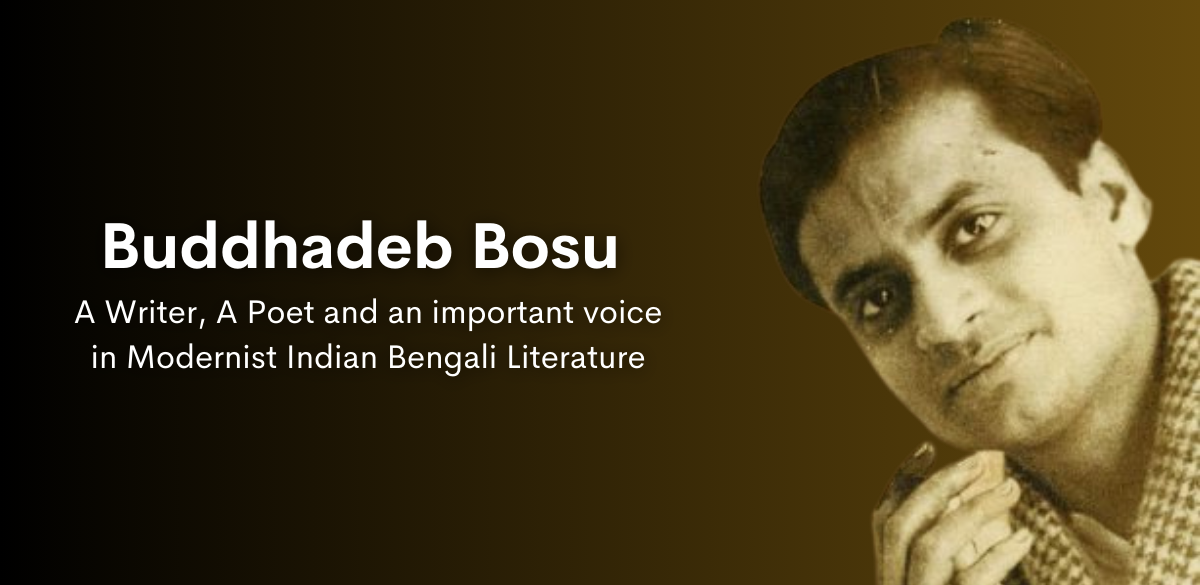
Buddhadeb Bosu is one of the most proclaimed modern Indian writers of the 20th century. Although he holds a great reputation in Bengali poetry, he was a versatile writer with his contributions to novels, short stories, plays, and essays. He is also considered one of the most versatile writers of Bengali literature after Tagore. In his commemoration today, on his birth anniversary, let’s celebrate his contribution to Indian literature and society.
Buddhadeb Bosu: Early Life
Born on 30th November 1908, Buddhadeb Bosu studied English literature at the University of Dhaka and resided in Jagannath Hall. In 1931, after completing a master of arts there he moved to Calcutta where he took private teaching sessions to financially sustain himself. He scored distinction marks, which were unsurpassable till 2007. He also obtained the highest possible marks in the first Binnet Intelligence Test, later known as the IQ test.
Now the battle is against the world, this world,
Buddhadeb Bosu
with me on one side, on the other your eyes silent, deep;
between us the meandering, dizzying path of this world.
Literary Life
While Buddhadeb Bosu was a student only, he started working for the Kallol magazine. Kallol magazine was the first literary movement that argued for embracing modernist techniques of literature in Bengali literature. This magazine was highly influenced by contemporary theorists such as Karl Marx and Sigmund Freud. Through the Kallol magazine, Buddhdeb significantly contributed to the emergence of many new writers and thinkers in Bengali literature. Later on, he worked as an editor and literary critic of the literary magazine Pragati. The establishment of the Kavita, the most prestigious poetry publication in Bengali, which he edited and published for 25 years, was one of his most significant contributions to Indian literature.
At the age of seventeen, Bandir Bandana, his debut poetry book, was released. Despite teaching at several colleges and institutions, he spent his entire life studying literature. Kavita Bhavan, the name of his Calcutta apartment, serves as a metaphor for this. In 1930, at the age of 18, he wrote his debut book, Saara. Despite writing almost 40 books, his epic novel Tithidore, released in 1949, is today regarded as a masterpiece and became his most admired work. He released over 160 titles in his lifetime.

Tagore’s influence was evident in Buddhadeb Bosu’s early writings. Although Bosu continued to have a great deal of respect for Tagore, he eventually departed from his influence. Instead, Bosu’s poetry turned more direct and personal. This transformation was sparked by Bosu’s admiration of Occidental or Western literature, which prompted and expanded his work. His poems reflected the influence of notable Western poets such as Baudelaire, Rilke, T. S. Eliot, William Butler Yeats, and Ezra Pound.
Awards and Recognition
Bosu continues to be an essential figure in Bengali writing from the 20th century to this day. Among the poets who came to represent Bengali modernism in the early 1900s, Buddhadeb Bosu played a pivotal role. For his verse drama Tapaswi-O-Tarangini, he was awarded the Sahitya Akademi Award in 1967. For Swagato Biday, he was presented with the Rabindra Puraskar in 1974. In 1970, he was awarded a Padma Bhushan.

Having overcome the accidents of Winter, Summer, Spring, and the Rains,
Buddhadeb Bosu
I welcome at my heart’s evening the void, the null, the absolute zero
No longer prey to the whimsy of the seasons, I rejoice
In freedom from function,
liberty from thought, lightness of death