

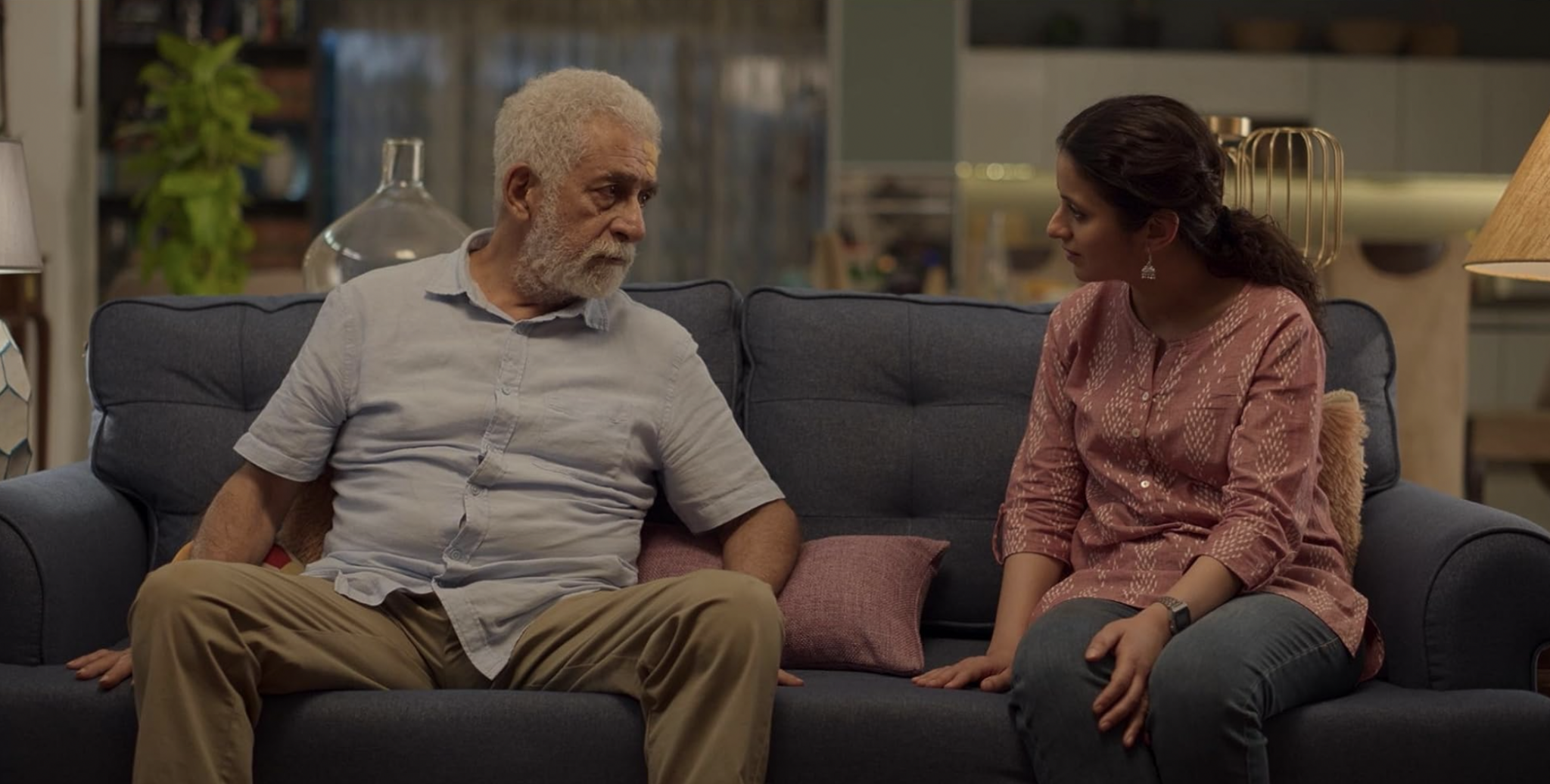
Humans are inherently emotional beings tied up in the turmoils of constantly manipulating themselves to become practical. What comes naturally to them ends up becoming calculative at the end of the day, stealing their true selves from themselves and circling around perfections and flaws. Chintan Sarda’s 23-minute short film, The Broken Table, explores two stories via the lens of a victim of this practicality-driven world.
Plot
The film opens with Dipti’s (played by Rasika Dugal) telephone conversation, hinting at a prospective element of the story and then shifts the landscape to Giri (played by Naseeruddin Shah), an Alzheimer’s patient. The film lays out the contrasts by Dipti, a young MA student, excited for her first live subject, aware of the reality. On the other hand, Giri, an old man, is forgetful of even his own grandson, the events of the day and his current life.
While Dipti is on a phone call with her gynaecologist trying to navigate her ‘flaw’ of incapability of childbearing and how her married life will be ruptured because of her ‘flaw’, Giri is away from his reality and still oscillating between the past and the present.
The Broken Table: Accepting and Reconnecting with True Self
Chintan Sarda weaves the film around conversations between two opposite characters, bringing out their similarities. Moreover, it conveys to the viewers – this is human nature, to connect with yourself and your surroundings and love them.

Learning about Giri’s intense love for his wife, Prabha and her death, Dipti starts understanding the tragedy behind Giri’s sad state. She notes her subject’s behaviour for her studies. And her subject, Giri notes her gullible and naive attitude towards life as both share a light conversation over a nose ring.
Soon their conversations take a significant turn, in which Dipti becomes Giri’s client. Initially, her intentions were to engage Giri in different activities until his family returned. However, she soon gives in and probably half-knowingly seeks relationship advice for her fears of ruptured marriage, as Giri acts as her lawyer.

Alongside, Giri narrates the story of his second-hand, broken table, imbibing the insecurity of his real identity. He shares the beauty of the human bond with Dipti recalling the times when Prabha painted a tree on the broken table, engulfing all the dead flaws into a living tree branch. The scene echoes Taylor Swift’s lyric from her song Cardigan, “You drew stars around my scars”. What eventually becomes a life analysis of Dipti serves as a reminder of what it is to love and its incomplete nature without flaws.
In the end, it is the climax that sets the landscape clear. It is straightforward in its essence and tells both Dipti and the viewers about the facade of what we think the reality is and what its flaws are. She realises her mistakes of assuming to be aware of herself, aware of her subject, who has better clarity than her, only failing by a tragic medical ailment. She realises love is beyond human flaws, and acceptance of these flaws and growing despite them is what love is.
The climax turns around the initially set differences into similarities, depicting the nature of humans and how you have to let it flow, not be so calculative about it, let things be a tad bit natural and move away from fixating your life on practicality. Human life is nothing without love. Whether it is in the present or in retrospect, it is love that keeps you moving.