

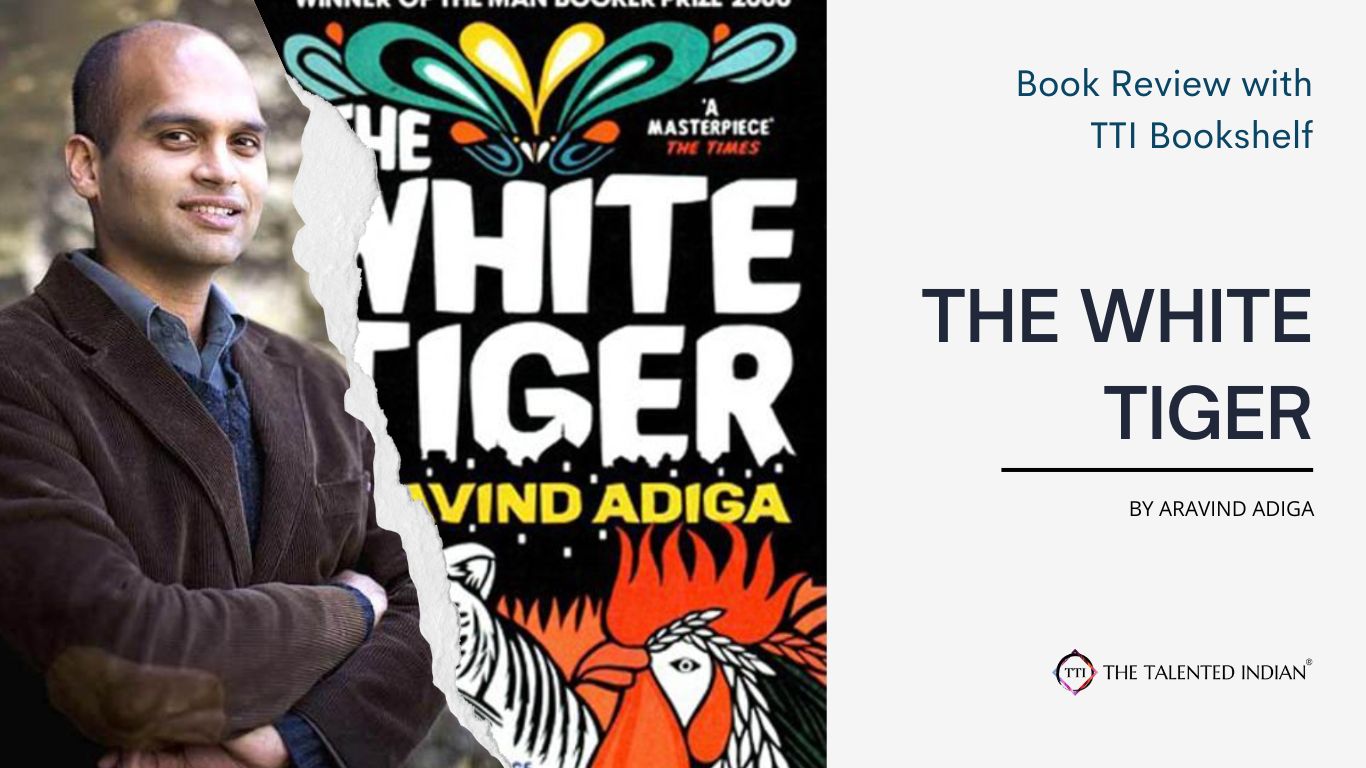
The White Tiger by Aravind Adiga was published in 2008 and won the Man Booker Prize in the same year. The book garnered mixed reactions from the readers for Adiga’s humorous portrayal of the social and class system in India. The novel partakes in quite the dark humour. A journalist by profession, this was Adiga’s very first novel. He was 33 at that time.
The Man Booker Prize committee emphasised on the novel’s humorous take on “a different aspect of India.” The committee also commented, “The book gains from dealing with pressing social issues and significant global developments with astonishing humour.” In a nutshell, Adiga tells a story of a man deprived of the riches belonging to the ‘darkness’ of Bihar’s poverty and decline, who climbs up the social ladder and becomes a part of the ‘light’ and ‘civilization’.
Summary
The White Tiger is a sultry, sarcastic, socially charged story of India in its binary of “dark” and “light”. We’re introduced to Balram Halwai, who refers to himself as a self-made man who knows the “real India” and must inform the Chinese Premier, Wen Jiabao about it, who is to make an official visit to the country. The story is told through a series of letters Balram writes to Wen Jiabao, narrating his life story.
Through the series of letters we learn that Balram Halwai was born in the village of Laxmangarh, Bihar. After the death of his father, Balram learns to drive and, through his skills and flattery, gets a job for the village’s landlord’s sons: Mukesh and Ashok. The story then takes forward in a new cityscape, where our narrator comes face to face with the corruption and social binaries that exist in the fabric of modern cities as well. For the sake of keeping it a spoiler-free review, we will not spill the ending of the novel, or one of the many crucial scenes that unfold in the story which forms the crux of Adiga’s goal.

The White Tiger: Social Commentary And Dark Humor
In The White Tiger, Aravind Adiga has used realistic and quite descriptive words and sentences to visibilise the social strata of India, which has been normalised in the country to the point that it is invisible to the naked eye.
Adiga compares the oppressed, lower class of the country with a ‘rooster coop’. The following lines, which are quite evocative, graphic and despairing, are a response to the unchanging social fabric of India, which is marred by poverty, hunger and unequal opportunities.

“Go to Old Delhi, and look at the way they keep chickens there in the market. Hundred of pale hens and brightly colored roosters, stuffed tightly into wire-mesh cages. They see the organs of their brothers lying around them. They know they are next, yet they cannot rebel. They do not try to get out of the coop. The very same thing is done with humans in this country.”
The lower class, economically oppressed, stamped upon, and blocked from entering the spaces of the rich and the well-off, have accepted their downtrodden destiny and have been made unconscious of even any rebellious thoughts in their mind. Unless, of course, like Balram Halwai, you take into the sludge of corruption, deceit, and crime to make your way upwards.
The Ending Of The Man Booker Prize Winner: A Question To Be Asked
There are far too many descriptive scenarios of the plight of the poor and the working class in The White Tiger. These scenes are an eye-opener to realistic perspectives of the people coming from underprivileged backgrounds. Moreover, Balram’s character is quite intriguing. There can be reasons why one might not like the character, or absolutely love him. His thoughts are malign, sometimes sympathetic, and Adiga forces the readers to understand his psyche.
Aravind Adiga leaves the novel at an intriguing end since it emanates both a success and a failure. The success is Balram Halwai’s triumph at making it upwards on the social ladder. He came from the ‘dark’ and the ‘uncivilized’ to the ‘light’ and the ‘civilized’ tech city of Bangalore. However, this prosperity and lavishness had come at the cost of washing one’s hands with the same corruption, greed, and deceit he has been criticising, mocking, and been a victim of since the start. The White Tiger leaves us with a question: will Balram Halwai become the perpetrator of the same corrupt scheme?


